Direct Answer
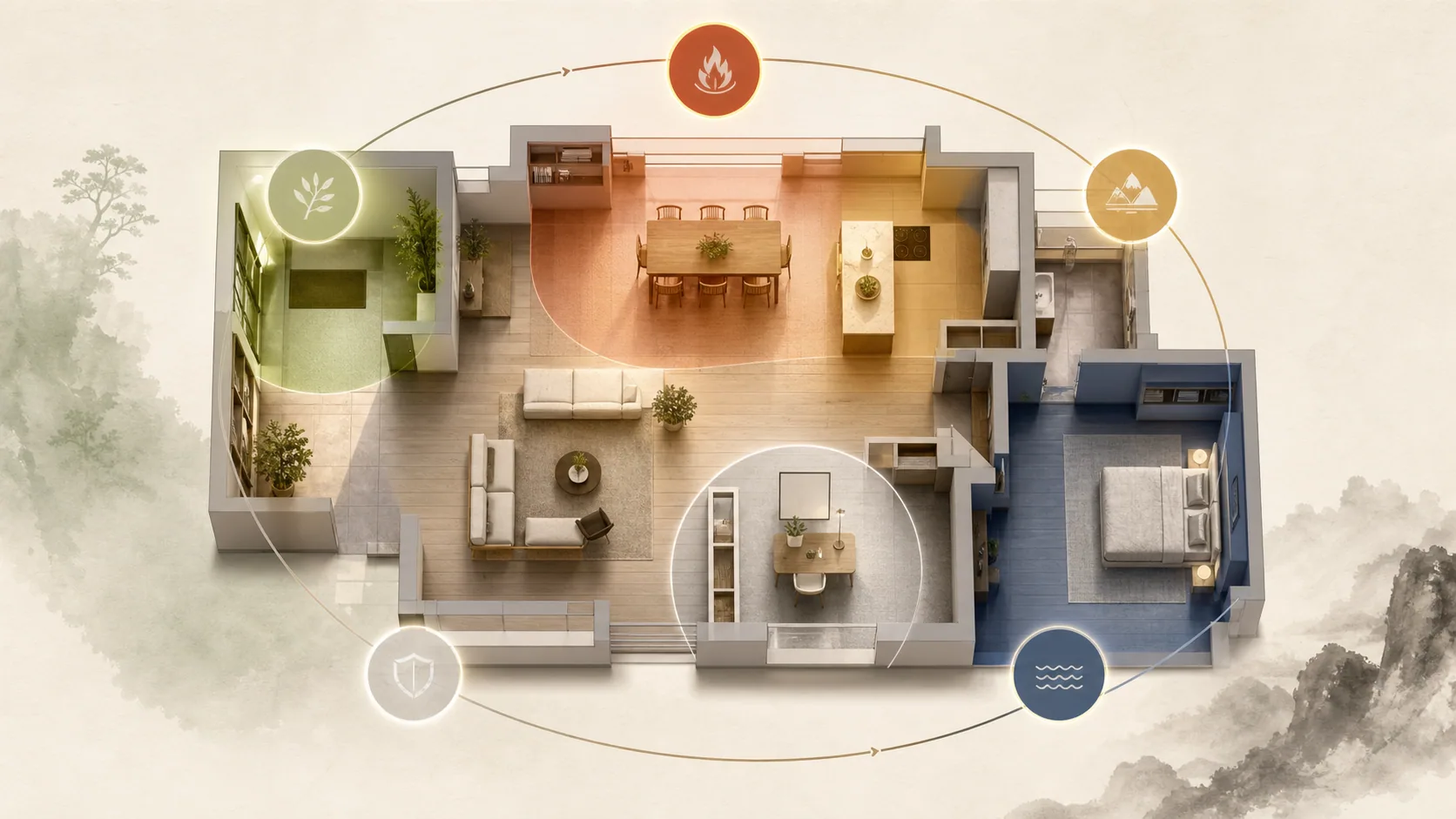
To use the Five Elements in your home, begin with the room's purpose.
- Use Wood where a room needs growth, freshness, direction, or creative movement.
- Use Fire where a room needs warmth, visibility, gathering, or expression.
- Use Earth where a room needs stability, nourishment, care, or grounding.
- Use Metal where a room needs order, refinement, boundaries, or clarity.
- Use Water where a room needs rest, privacy, depth, recovery, or flow.
Then ask whether the room has too much, too little, or the wrong kind of energy for its job. Adjust pathway, light, texture, sound, storage, surface, and activity before relying on symbolic objects. The goal is calibration, not superstition.
Source Discipline
This guide follows four boundaries.
- Classical anchor: Wu Xing, or the Five Phases, is a Chinese framework of Wood, Fire, Earth, Metal, and Water as movement qualities and relationships.
- Feng Shui context: in spatial practice, the Five Elements are used to read the quality of place through form, material, activity, direction, brightness, containment, and flow.
- Modern translation: this guide translates these ideas for North American homes through observable qualities: how a room supports attention, recovery, movement, gathering, and boundaries.
- Claim boundary: this article does not promise wealth, romance, health, protection, or success from colors, objects, directions, or rituals.
Chinese Cultural Root / 中国文化根基
Using the Five Elements at home should stay connected to 五行 (Wu Xing), not drift into a generic styling formula.
In Chinese spatial thinking, Wood, Fire, Earth, Metal, and Water are not just colors or objects. They are qualities of movement and relationship. A plant, lamp, ceramic bowl, metal tray, or dark textile only matters if it supports the room's purpose and the rhythm of life inside it.
For modern homes, the goal is not to make a room look "Chinese." The goal is to keep the Chinese pattern language intact while applying it with restraint.
That distinction protects the article from becoming decor content. A room can be visually beautiful and still fail its purpose. A bedroom can look expensive but keep the body alert. A desk can look minimal but still scatter decisions. Five Elements practice becomes useful only when it reads function, not surface style.
The Most Important Rule: Start With the Room's Job
Many Five Elements home guides begin with a shopping list:
- add a plant,
- add a red candle,
- add a metal bowl,
- add a water feature,
- add a crystal or ceramic object.
That approach is too shallow.
The Five Elements are not a decorative checklist. They are a way to ask whether a space is doing its job.
A bedroom should help the body come down. A home office should help attention become clear. An entryway should help people cross from outside to inside without friction. A kitchen should support nourishment and practical care. A living room should hold gathering without exhausting the people in it.
Once the room's job is clear, the Five Elements become useful.
The question is not:
Which object brings luck?
The better question is:
Which quality would help this room perform its purpose with more coherence?
A Thirty-Minute Room Test
Before buying anything, test one room for thirty minutes.
Stand at the doorway and name the first signal. Is the room showing rest, work, storage, gathering, or unfinished decisions?
Walk the main path. Does movement open naturally, or does the body need to avoid furniture, objects, bags, cords, or piles?
Look at the strongest light source. Does it match the room's job, or is it too bright, too dim, too cold, or too theatrical for the activity?
Name one dominant phase and one missing phase. A room may have strong Earth storage but weak Wood movement. It may have Fire light but weak Water recovery. It may have Metal order but weak Fire warmth.
Then change one thing only. Move an object, clear a path, soften a light, define a surface, or close a work signal. If the room's behavior becomes easier, the reading had practical value.
The Five Elements as Room Qualities
In a home, the Five Elements can be read through more than color. Color matters, but it is only one signal.
Wood: Growth, Freshness, Direction
Wood appears through upward movement, living forms, clear direction, fresh air, flexible plans, and a sense of beginning.
Wood can be supported by:
- vertical lines,
- healthy plants when appropriate,
- breathable pathways,
- natural materials,
- a visible next step for projects,
- morning light,
- fresh air and seasonal renewal.
Too little Wood can make a room feel stale, blocked, or directionless. Too much Wood can feel restless, unfinished, or constantly expanding.
Fire: Warmth, Visibility, Expression
Fire appears through light, heat, social energy, visibility, celebration, attention, and expressive focal points.
Fire can be supported by:
- warm lighting,
- a clear gathering point,
- candles used safely,
- art or objects with emotional brightness,
- active conversation zones,
- sun exposure,
- a sense of welcome and human presence.
Too little Fire can make a room feel cold, silent, or emotionally absent. Too much Fire can make a room overstimulating, performative, or hard to rest in.
Earth: Stability, Nourishment, Support
Earth appears through grounded surfaces, containment, regularity, care, food, ceramics, textiles, and a sense of being held.
Earth can be supported by:
- stable tables,
- grounded seating,
- calm storage,
- ceramics or stone,
- nourishing colors and textures,
- meal rituals,
- a centered layout.
Too little Earth can make a room feel scattered or unsupported. Too much Earth can feel heavy, cluttered, stagnant, or overfull.
Metal: Clarity, Boundary, Refinement
Metal appears through order, editing, clean edges, tools, standards, boundaries, completion, and negative space.
Metal can be supported by:
- clear surfaces,
- defined storage,
- refined objects,
- good tools,
- white or pale space,
- thoughtful symmetry,
- visible endings and closed loops.
Too little Metal can make a room feel messy, blurred, or difficult to decide in. Too much Metal can feel cold, rigid, overly controlled, or emotionally thin.
Water: Rest, Depth, Flow
Water appears through quiet, privacy, reflection, darkness, depth, softness, listening, and the ability to recover.
Water can be supported by:
- lower light,
- protected quiet,
- reflective surfaces used with care,
- darker accents,
- soft sound,
- fewer public-facing cues,
- a slower rhythm.
Too little Water can make a room feel dry, exposed, or unable to restore. Too much Water can feel vague, dim, avoidant, or emotionally heavy.
How to Apply the Five Elements Room by Room
The following examples are not fixed formulas. They are diagnostic starting points.
Entryway
The entryway is a threshold. Its job is to help people arrive, release outside pressure, and move clearly into the home.
Useful phases:
- Wood for movement and direction,
- Metal for order and editing,
- Earth for grounded arrival.
Practical adjustments:
- Keep the first step inside clear.
- Give keys, shoes, coats, and bags a defined place.
- Use light that makes arrival feel intentional, not harsh.
- Remove objects that make the threshold feel like storage.
- Add one living or vertical cue only if it does not block movement.
The goal is not to "attract luck." The goal is to make transition coherent.
Bedroom
The bedroom's primary job is recovery. It should help the nervous system leave performance mode.
Useful phases:
- Water for rest and privacy,
- Earth for support and containment,
- Metal for boundaries and endings.
Use Fire carefully. A bedroom with too much Fire can feel visually loud, socially exposed, or emotionally stimulating.
Practical adjustments:
- Reduce visible work cues.
- Create a clear end-of-day surface: phone, book, water, lamp.
- Use lower lighting at night.
- Keep storage from pressing visually on the bed.
- Let the bed feel supported without turning the room into a storage zone.
The Five Elements question is simple: does this room cool, contain, and protect recovery?
Home Office
The home office should help attention become clear and work become complete.
Useful phases:
- Wood for planning and forward movement,
- Metal for priority, structure, and decisions,
- Earth for support and consistency.
Too much Fire can create constant urgency. Too much Water can create drifting. Too much Metal can make the room sterile and tense.
Practical adjustments:
- Keep the desk oriented toward one clear task zone.
- Use one visible planning surface, not many scattered lists.
- Create a real ending ritual: close the laptop, clear the desk, turn off the task light.
- Add warmth if the space feels overly strict.
- Add boundaries if the space bleeds into sleep, meals, or family time.
The goal is not productivity obsession. It is clean attention and clean completion.
Living Room
The living room holds gathering, conversation, recovery, and shared presence. It often needs several phases in a balanced way.
Useful phases:
- Fire for warmth and human presence,
- Earth for comfort and holding,
- Wood for liveliness,
- Metal for editing,
- Water for calm after social energy.
Practical adjustments:
- Create a clear conversation shape.
- Keep pathways open so movement feels easy.
- Use layered lighting rather than one harsh source.
- Edit visual clutter so the room can breathe.
- Keep one restorative corner for quiet reading or decompression.
The living room should not be all display. It should support real human rhythm.
Kitchen and Dining
The kitchen and dining area carry strong Earth because they involve food, care, routine, and nourishment. They may also carry Fire through heat, cooking, and social warmth.
Useful phases:
- Earth for nourishment,
- Fire for cooking and warmth,
- Metal for cleanliness and tools,
- Wood for freshness,
- Water for flow and cleanup.
Practical adjustments:
- Make the most-used tools easy to reach.
- Keep preparation surfaces clear enough for real use.
- Add freshness through produce, herbs, or seasonal rhythm.
- Keep Fire from becoming stress: reduce harsh lighting and visual chaos.
- Treat cleanup as part of the rhythm, not an afterthought.
The kitchen is not only a functional zone. It is a daily ritual zone.
Bathroom and Restorative Zones
Bathrooms and small restorative corners often carry Water. Their job is cleansing, release, privacy, and reset.
Useful phases:
- Water for cleansing and restoration,
- Metal for hygiene and clarity,
- Earth for grounding,
- Wood in small amounts for renewal.
Practical adjustments:
- Keep surfaces clean and simple.
- Fix visual irritations that create tiny daily friction.
- Use texture to avoid a cold, clinical feeling.
- Keep scent subtle rather than overwhelming.
- Let the space signal release, not storage overflow.
Water needs containment. Without Metal and Earth, restorative spaces can become damp, messy, or vague.
A Five Elements Home Audit
Use this audit when a room feels wrong but you cannot name why.
- Name the room's job. Is this room for rest, work, arrival, nourishment, gathering, or recovery?
- Name the dominant phase. Does the room feel more Wood, Fire, Earth, Metal, or Water?
- Ask if that phase serves the job. Strong Fire may help a dining room but harm sleep. Strong Metal may help a desk but weaken warmth in a living room.
- Look for excess. Is the room too restless, hot, heavy, rigid, or dim?
- Look for absence. Is it missing movement, warmth, support, clarity, or rest?
- Use the cycles. Add support through the generating cycle, or add regulation through the controlling cycle.
- Make one concrete adjustment. Change a pathway, light source, surface, storage rule, object density, sound level, or evening rhythm.
- Observe for seven days. A real home practice is tested through lived experience, not belief pressure.
Using the Generating and Controlling Cycles at Home
The generating cycle helps when a room needs support.
Examples:
- A cold living room may need Wood before Fire: fresher movement, better seating direction, then warmer light.
- A scattered desk may need Earth before Metal: stable routines before stricter organization.
- A dry creative space may need Water before Wood: recovery and reflection before new ideas.
The controlling cycle helps when a room has excess.
Examples:
- Too much Fire in a bedroom: use Water through quiet, lower light, privacy, and slower rhythm.
- Too much Earth in a storage-heavy room: use Wood through pathways, verticality, and visible next action.
- Too much Metal in a living room: use Fire through warmth, voice, texture, and human presence.
These are not cures. They are cultural pattern readings translated into practical spatial choices.
What Not to Do
Do not treat the Five Elements as a rigid rule that every room must contain equal amounts of Wood, Fire, Earth, Metal, and Water.
Do not assume one color fixes a room.
Do not buy symbolic objects before understanding the room's actual function.
Do not use Feng Shui or the Five Elements to blame yourself, your family, your home, or your life circumstances.
Do not promise that a plant, mirror, fountain, candle, crystal, metal object, or direction will guarantee money, romance, healing, protection, or success.
A better method is quieter and more demanding: read the room honestly, make one respectful adjustment, and observe what changes.
Where to Continue
For the full definition, read What Are the Five Elements in Chinese Culture?. To understand the generating and controlling cycles, read How Do the Five Elements Work?. To connect this home practice to Feng Shui, read What Is Chinese Feng Shui? and Feng Shui Without Superstition. For cultural source boundaries, use the Chinese Cultural Source Library.
FAQ
How do I use the Five Elements in my home?
Use the Five Elements by matching room function with room quality. Wood supports growth and direction, Fire supports warmth and visibility, Earth supports stability and nourishment, Metal supports clarity and boundaries, and Water supports rest and recovery. Adjust light, pathway, storage, surface, activity, and atmosphere before relying on symbolic objects.
Do I need all five elements in every room?
No. A room does not need equal amounts of all five elements. It needs the qualities that help it perform its purpose. A bedroom may need more Water, Earth, and Metal; a dining room may need more Earth and Fire; a home office may need Wood, Metal, and Earth.
Which Five Element is best for a bedroom?
For most bedrooms, Water, Earth, and Metal are most useful: Water for rest and privacy, Earth for support, and Metal for boundaries and clean endings. Fire should usually be gentle because too much visual heat or stimulation can weaken recovery.
Is using the Five Elements in a home the same as superstition?
It can become superstitious if it promises guaranteed outcomes from objects or colors. Use the Five Elements as a cultural framework for observing room purpose, movement, light, material, order, and rest, not as a guarantee of wealth, romance, protection, or health.
What is the difference between Five Elements and Feng Shui?
The Five Elements, or Wu Xing, are a Chinese framework of Wood, Fire, Earth, Metal, and Water as movement qualities and relationships. Feng Shui is a broader spatial tradition concerned with how place, orientation, pathways, Qi, and placement shape human experience. Feng Shui often uses the Five Elements as one of its interpretive languages.
Can colors represent the Five Elements?
Yes, colors can represent the Five Elements, but they should not be treated as the whole practice. Green can suggest Wood, red can suggest Fire, yellow or brown can suggest Earth, white or metallic tones can suggest Metal, and black or deep blue can suggest Water. In a real room, form, material, light, activity, and placement matter just as much.