Direct Answer
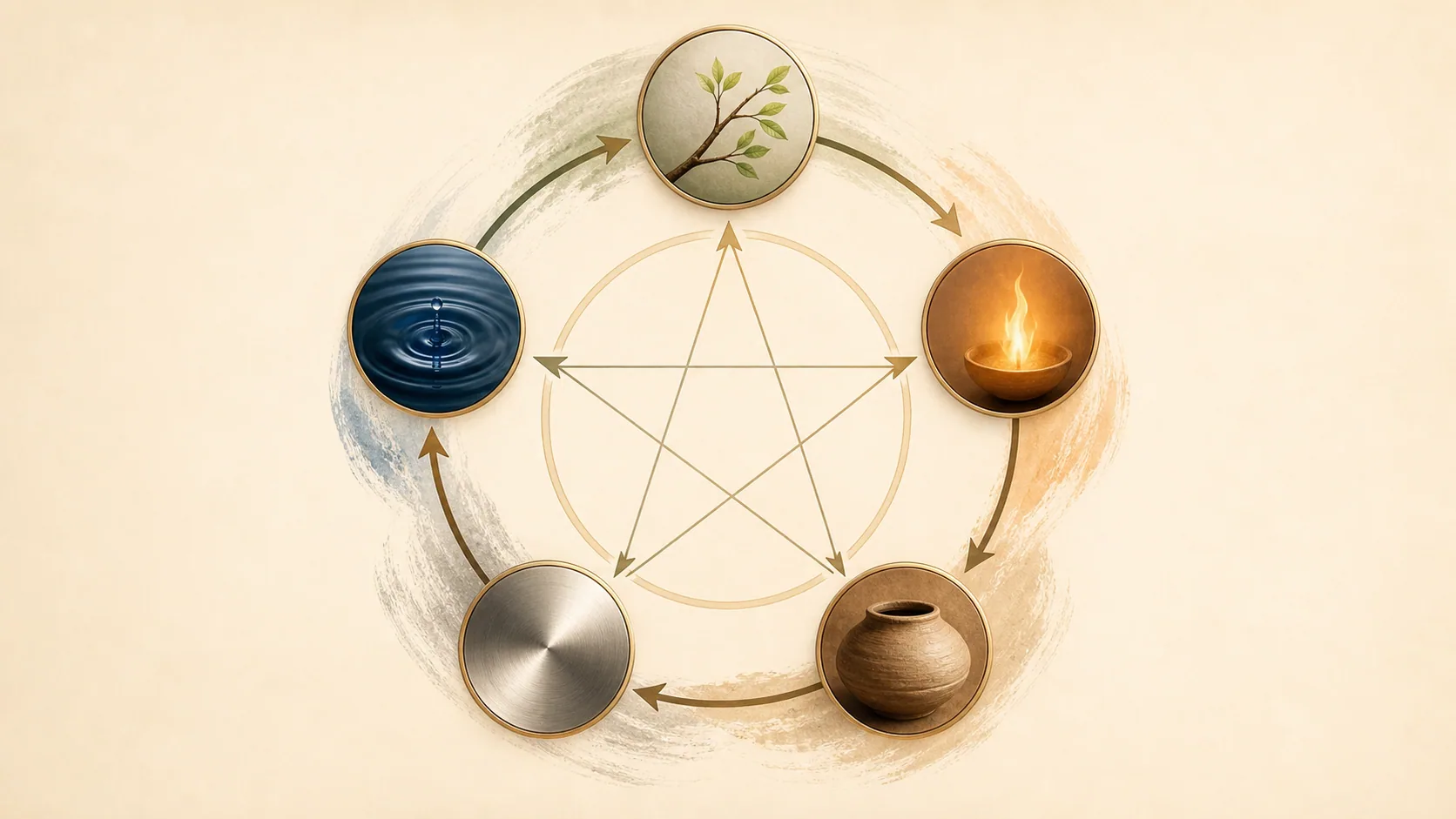
The Five Elements work through two main cycles: the generating cycle and the controlling cycle.
In the generating cycle:
- Wood feeds Fire.
- Fire creates Earth.
- Earth bears Metal.
- Metal enriches or carries Water.
- Water nourishes Wood.
In the controlling cycle:
- Wood parts Earth.
- Earth contains Water.
- Water cools Fire.
- Fire melts Metal.
- Metal cuts Wood.
These cycles are not magic formulas. They are Chinese cultural relationship maps for understanding how growth, expression, stability, refinement, and restoration support or regulate one another.
Source Discipline
This article follows three boundaries.
- Classical anchor: Wu Xing appears in early Chinese correlative thought as a framework of five named processes: Water, Fire, Wood, Metal, and Earth. The Hong Fan chapter of the Shang Shu is a major early reference point for the five and their movement qualities.
- Traditional development: later Chinese traditions use generating and controlling relationships across cosmology, medicine, calendar systems, Feng Shui, music, governance, and symbolic correspondence.
- Modern interpretation: when this article describes the cycles as "support," "regulation," or "calibration," it is translating the logic for modern North American readers. These are not medical, financial, or deterministic laws.
Chinese Cultural Root / 中国文化根基
The generating and controlling cycles are part of the Chinese Wu Xing system, written 五行. The five are 木 Wood, 火 Fire, 土 Earth, 金 Metal, and 水 Water.
These cycles matter because Chinese correlative thinking often reads reality through relationship rather than isolated categories. A phase is understood by what it supports, what supports it, what regulates it, and what it regulates.
In English, the two cycles are often called the generating cycle and the controlling cycle. In Chinese-language discussion they are commonly associated with 生 (sheng, generating or giving rise) and 克 (ke, restraining or regulating). AETERA often explains ke as regulation because "control" can sound punitive in English, while the stronger cultural point is balance through relationship.
The language of "support" and "regulation" is modern English. The relational root is Chinese.
Why the Cycles Matter
Many English explanations stop at a list:
- Wood
- Fire
- Earth
- Metal
- Water
That list is useful for beginners, but it is incomplete.
Wu Xing means more than five names. The system becomes meaningful when the five phases interact. Wood does not simply "exist." It feeds Fire, is nourished by Water, parts Earth, and is cut by Metal. Fire does not simply mean passion. It receives support from Wood, creates Earth, melts Metal, and is cooled by Water.
This is why the phrase Five Phases is often more precise. A phase moves. It affects another phase. It becomes excessive, depleted, supported, or regulated depending on context.
The cycles matter because they change the question from:
Which element am I?
to:
What relationship is active, missing, excessive, or asking for adjustment?
That second question is much closer to the real value of the system.
The Generating Cycle
The generating cycle is often called the creative, nourishing, or productive cycle. It describes how each phase supports the next.
Wood Feeds Fire
Wood provides fuel for Fire. Symbolically, direction, growth, planning, and renewal can support visibility, expression, warmth, and action.
In modern terms, a project often needs Wood before Fire. It needs a clear path, enough freshness, and a living sense of direction before it can be shared publicly.
Without healthy Wood, Fire can become forced performance. A person may try to be visible before the work has roots.
Fire Creates Earth
Fire produces ash, which returns to Earth. Symbolically, expression, visibility, and transformation eventually need to become stable, integrated, and useful.
In modern terms, a strong presentation, launch, or social moment should leave behind structure: learning, trust, rhythm, or practical support.
Without Earth, Fire burns bright but leaves no center. There is attention, but no integration.
Earth Bears Metal
Metal is found within Earth. Symbolically, stable support and containment allow value, standards, discernment, and structure to emerge.
In modern terms, good routines create better decisions. A grounded household, team, or practice can produce cleaner boundaries and stronger judgment.
Without Earth, Metal becomes abstract. Standards exist, but there is not enough support to live them.
Metal Enriches or Carries Water
This relationship is often explained in different ways: Metal can collect dew, conduct water, enrich water through mineral quality, or create the vessel that carries water. Symbolically, refinement and boundaries make depth and restoration possible.
In modern terms, Water often needs Metal first. Sleep improves when work has an ending. Deep thinking improves when distractions are cut. Privacy improves when boundaries are clear.
Without Metal, Water can become vague. There is a wish for rest, but no structure protecting it.
Water Nourishes Wood
Water nourishes growth. Symbolically, rest, depth, memory, and renewal support new direction.
In modern terms, the next meaningful beginning often comes after recovery. A person who has slept, reflected, and returned inward can find better Wood: clearer planning, stronger direction, and more flexible growth.
Without Water, Wood becomes dry pressure. Growth continues, but vitality thins.
The Controlling Cycle
The controlling cycle is sometimes misunderstood because the word control sounds harsh in English. A better first reading is regulation.
The controlling cycle describes how one phase prevents another from becoming excessive.
Wood Parts Earth
Roots move through soil. Symbolically, growth, direction, and movement can break up heaviness, stagnation, and over-containment.
In modern terms, too much Earth can look like over-responsibility, clutter, caretaking without movement, or a routine that has become too heavy. Wood regulation adds movement, planning, fresh air, and a path forward.
Earth Contains Water
Earth shapes rivers and holds water in banks. Symbolically, stability, containment, and practical support can regulate drifting, fear, overwhelm, or formlessness.
In modern terms, when Water becomes too much, a person may overthink, withdraw, avoid decisions, or lose daily rhythm. Earth regulation adds meals, routines, touchpoints, and grounded responsibility.
Water Cools Fire
Water reduces excess heat. Symbolically, rest, privacy, depth, and reflection can regulate overstimulation, drama, exposure, and speed.
In modern terms, too much Fire can look like burnout, constant visibility, urgent messaging, emotional reactivity, or social overextension. Water regulation adds quiet, sleep, privacy, and a lower-stimulation rhythm.
Fire Melts Metal
Fire softens Metal. Symbolically, warmth, expression, and human connection can regulate rigidity, excessive control, coldness, or perfectionism.
In modern terms, too much Metal can look like severe standards, harsh editing, emotional distance, or an inability to receive warmth. Fire regulation adds presence, conversation, humor, light, and relational warmth.
Metal Cuts Wood
Metal cuts and shapes Wood. Symbolically, boundaries, standards, decisions, and refinement can regulate overgrowth, scattered ambition, and endless starting.
In modern terms, too much Wood can look like pressure, impatience, too many projects, or growth without completion. Metal regulation adds editing, priority, closure, and clear limits.
Support Is Not Always Better
One of the biggest mistakes in popular Five Elements content is assuming the generating cycle is always good and the controlling cycle is always bad.
That is too simple.
Support can become excess. If Wood keeps feeding Fire when Fire is already overactive, the result may be burnout, urgency, or social overstimulation. If Earth keeps supporting Metal when Metal is already rigid, the result may be even more control and less warmth.
Regulation can be healthy. Water cooling Fire is not an attack on Fire. It may be exactly what Fire needs to become sustainable. Metal cutting Wood is not anti-growth. It may turn raw growth into meaningful form.
A mature Five Elements reading asks:
- What is being supported?
- Is that support needed or excessive?
- What is being regulated?
- Is that regulation healthy or oppressive?
- What phase would restore the whole system?
This is why Wu Xing is a relationship framework, not a simple list of lucky or unlucky elements.
A Simple Example: Burnout
Imagine someone who is always visible. They answer messages quickly, present well, take on public-facing work, and keep momentum high. From the outside, they look successful. Inside, they feel thin, reactive, and unable to recover.
An elemental reading might see strong Fire and Wood:
- Wood: constant growth, planning, and forward motion.
- Fire: visibility, expression, speed, and attention.
The missing support may be Water and Metal:
- Water: sleep, quiet, privacy, depth, recovery.
- Metal: boundaries, endings, standards, protected time.
The generating cycle says Water nourishes Wood, so real growth may require better recovery. The controlling cycle says Water cools Fire, so rest is not laziness. It is regulation.
A practical calibration might be:
- Use a Metal rule to end work at a visible time.
- Reduce Fire exposure after sunset.
- Add a Water ritual before sleep: dim light, no public input, no performance.
- Let Wood planning happen after recovery, not during exhaustion.
This is how the cycles become useful. They point toward adjustment.
A Simple Example: A Stagnant Room
Now imagine a room that feels heavy. It has storage everywhere, low movement, too many objects, soft lighting all day, and no clear purpose. It is comfortable, but it does not help anyone begin.
An elemental reading might see excess Earth:
- containment,
- accumulation,
- heaviness,
- over-support without movement.
The controlling cycle says Wood parts Earth. That means the room may need Wood qualities:
- vertical movement,
- clearer pathways,
- a living plant if appropriate,
- a defined project zone,
- fresh light,
- one visible next step.
The goal is not to buy a lucky plant. The goal is to restore movement where support has become stagnation.
The Cycles in Feng Shui
In Feng Shui, the Five Elements are not only about objects or colors. They are about the felt quality of a space.
A room may carry:
- Wood through growth, verticality, plants, freshness, and direction.
- Fire through light, warmth, visibility, gathering, and expressive focal points.
- Earth through stability, grounded surfaces, square forms, ceramics, and nourishment.
- Metal through order, refinement, clear boundaries, tools, and clean negative space.
- Water through quiet, flow, privacy, reflection, darkness, and restoration.
The cycles help ask better questions.
If a bedroom has too much Fire, adding more visual stimulation will not help recovery. Water may be needed.
If an office has too much Water, more softness may not help decisions. Earth containment or Metal structure may be needed.
If a creative room has too much Metal, more organization may not restore vitality. Fire warmth or Wood movement may be needed.
The point is not formula. The point is relationship.
The Cycles in Personal Reflection
The Five Elements can describe personal tendencies, but they should not be reduced to fixed identity.
Instead of saying "I am a Fire person," a more useful sentence is:
Fire is strong in how I work, but Water and Metal need more support.
Instead of saying "Water is bad for me," a more careful sentence is:
Water may be overactive in this season, so Earth structure may help me return to rhythm.
Instead of saying "Metal controls Wood, so Metal is negative," a better reading is:
Metal can help Wood become focused when growth has become scattered.
This shift protects the system from becoming fatalistic. It also makes it more practical.
Common Misunderstandings
The first misunderstanding is that generating means good and controlling means bad. In Wu Xing, both support and regulation are necessary.
The second is that the cycles are literal mechanical laws. They are cultural relationship maps, not laboratory claims.
The third is that one element can solve everything. A room, relationship, or person usually contains many phases at once.
The fourth is that Five Elements practice should become object shopping. Buying a red candle, metal bowl, or water fountain does not guarantee wealth, romance, healing, protection, or success.
The fifth is that the cycle can replace professional advice. It cannot. Wu Xing can support cultural translation, spatial reflection, ritual design, and self-awareness, but it is not medical, psychological, financial, architectural, or legal diagnosis.
How to Use the Cycles Without Superstition
Use the Five Elements cycles as a practical reflection process.
First, name the dominant phase:
- Is this situation full of Wood growth, Fire exposure, Earth heaviness, Metal rigidity, or Water withdrawal?
Second, ask whether that phase is healthy or excessive.
Third, look for support:
- What phase would nourish the system without exaggerating the imbalance?
Fourth, look for regulation:
- What phase would gently limit the excess?
Fifth, make one concrete adjustment.
Examples:
- Too much Fire at night: add Water through privacy, quiet, darkness, and slower rhythm.
- Too much Wood in work: add Metal through priorities, deadlines, and clean endings.
- Too much Earth at home: add Wood through pathways, fresh air, and a clearer next action.
- Too much Metal in relationships: add Fire through warmth, expression, and human contact.
- Too much Water in decision-making: add Earth through routine and one grounded commitment.
The preferred approach is not belief pressure, but careful calibration.
Where to Continue
For the full definition of Wu Xing, read What Are the Five Elements in Chinese Culture?. For the direct answer page, use Five Elements in Chinese Culture. To study each phase separately, read Wood, Fire, Earth, Metal, and Water. For source boundaries, use the Chinese Cultural Source Library.
FAQ
What are the two main Five Elements cycles?
The two main Five Elements cycles are the generating cycle and the controlling cycle. The generating cycle shows how phases support one another, while the controlling cycle shows how phases regulate one another.
What is the Five Elements generating cycle?
The generating cycle is Wood feeds Fire, Fire creates Earth, Earth bears Metal, Metal enriches or carries Water, and Water nourishes Wood.
What is the Five Elements controlling cycle?
The controlling cycle is Wood parts Earth, Earth contains Water, Water cools Fire, Fire melts Metal, and Metal cuts Wood.
Is the controlling cycle bad?
No. Controlling means regulation, not punishment. A phase may need to be regulated when it becomes excessive.
Are the Five Elements literal materials?
Not only. Wood, Fire, Earth, Metal, and Water are symbolic anchors for movement qualities, relationships, and processes.
Can the Five Elements be used in Feng Shui?
Yes. In Feng Shui, the Five Elements can help read the quality of a room through material, light, shape, flow, placement, activity, and atmosphere. They should not be used to promise guaranteed outcomes.
Can I use the Five Elements to understand myself?
Yes, as reflection. The Five Elements can help name patterns of growth, visibility, support, boundaries, and recovery, but they should not be treated as fixed personality destiny.