What are the Five Elements in Chinese culture?
The Five Elements are Wood, Fire, Earth, Metal, and Water. This concise guide answers the familiar English question; the Five Phases guide explains the translation and process-based philosophy in more depth.
The short answer
A concise definition with the boundaries needed to use it carefully.
The Five Elements in Chinese culture are Wood (木), Fire (火), Earth (土), Metal (金), and Water (水). In Chinese they are called Wu Xing (五行). Five Elements is the familiar English name; Five Phases is more precise because these are movement patterns rather than five isolated substances.
Understanding Wood, Fire, Earth, Metal, and Water as a Chinese pattern language for change.
Fixed personality typing, guaranteed compatibility, lucky colors, or destiny claims.
For voluntary reflection, choose one quality you want to support now: direction, warmth, support, boundary, or recovery.
Explore translation and process
Read why Wu Xing is often taught as Five Phases and how relationship changes the meaning.
See a modern home application
Apply Wood, Fire, Earth, Metal, and Water without superstition.
Find your year element
Use the educational calculator, then read its calendar and identity boundaries.
Start with the real question
People rarely come to this topic for trivia alone. These are the real-life questions the cultural framework can help clarify, without diagnosis or guaranteed outcomes.
You want the simple list of the Chinese Five Elements.
The answer is Wood, Fire, Earth, Metal, and Water. The important cultural point is that Wu Xing describes relationships and movement, not five isolated substances.
Start with the five names. For reflection, AETERA uses growth, expression, stabilization, refinement, and restoration as modern interpretive bridges, not standard translations.
You want to know how the Five Elements actually work.
The system becomes useful through relationship: the generating cycle explains support, and the controlling cycle explains regulation.
Read the cycles next, then apply the framework to one concrete situation such as a room, work rhythm, or recovery pattern.
You want to find your Chinese element.
A simple year element is a beginner doorway, but it is not a complete Bazi chart or a fixed personality label.
Use the Chinese Element Calculator for a first answer, then return to Wu Xing to understand the cultural meaning safely.
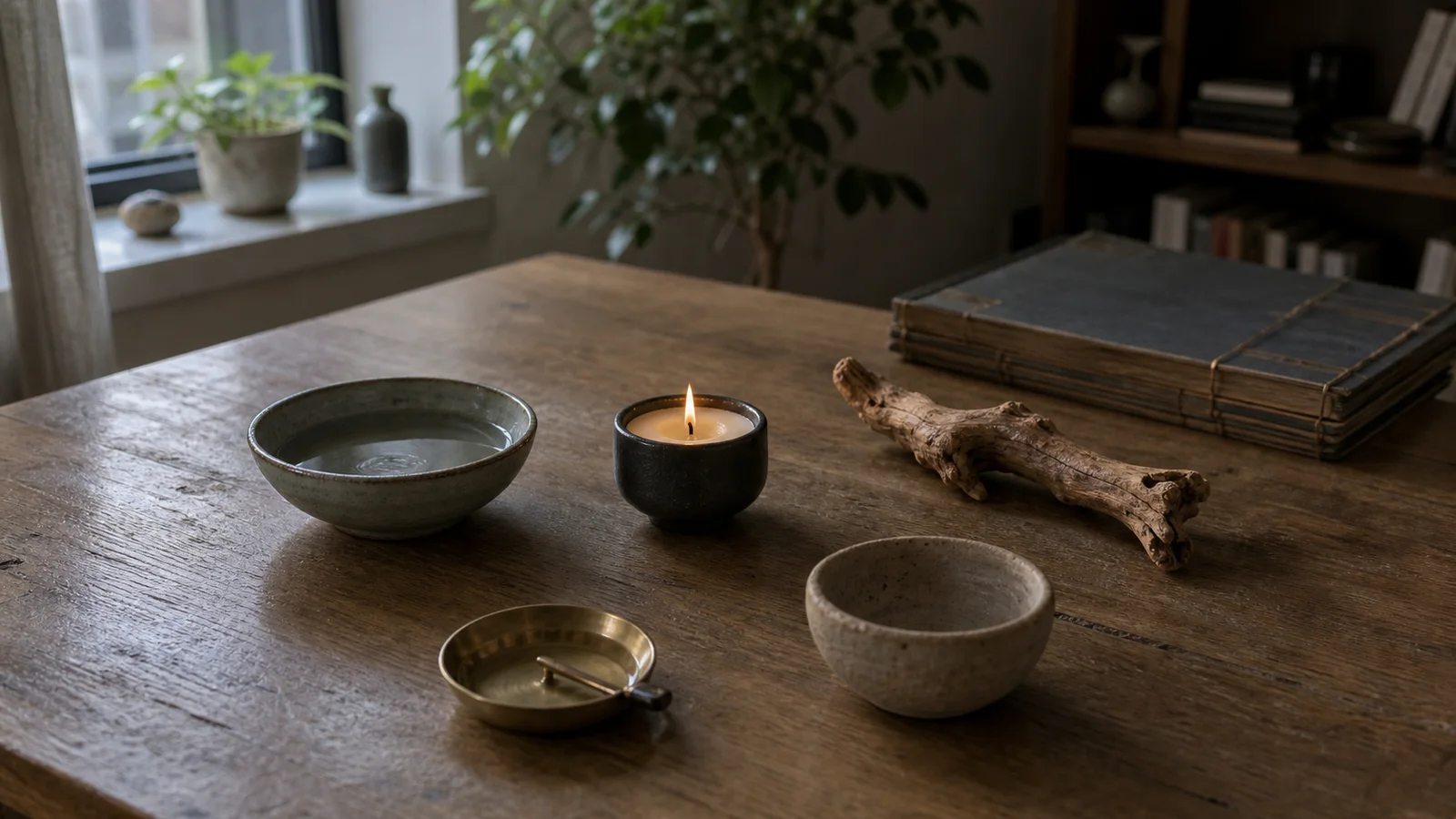
The Five Elements become easier to read through material qualities: wood, flame, clay, metal, and water as phases of movement rather than isolated substances.
The branch suggests growth, direction, and extension.
Flame and clay show visibility, warmth, stability, and containment.
Metal and water show boundary, refinement, depth, and restoration.
How this guide stays grounded
This guide is written as cultural translation for English-speaking readers. It gives direct definitions, Chinese terms, translation boundaries, common misunderstandings, and practical contexts before application.
Last updated on August 13, 2026 using AETERA's public editorial method: source context, translation boundaries, modern-application labels, claim checks, and a correction path.
Wu Xing (五行) is treated as a Chinese correlative pattern system. The Hong Fan chapter of the Shang Shu is one early source context for the five movement qualities.
Five Elements is the familiar English name. This page gives the concise list and basic meaning; the Five Phases guide explains why Xing points to movement, process, and relational change.
This page does not treat Wood, Fire, Earth, Metal, and Water as fixed personality types, fate labels, or guaranteed outcomes.
Continue Learning
Use these next pages to move from definition into application.
Study the Generating and Controlling Cycles
See how the five relate through support and regulation.
See a Modern Home Application
A practical room-by-room application without superstition.
Understand the Five Phases Translation
Read the process and relationship logic behind the familiar Five Elements name.
Find Your Chinese Year Element
An educational year-element doorway with calendar and identity boundaries.
Common Questions
What are the Five Elements in Chinese culture?
The Five Elements in Chinese culture are Wood, Fire, Earth, Metal, and Water. In Chinese they are called Wu Xing, or Five Phases.
What is Wu Xing?
Wu Xing (五行) is the Chinese framework behind the Five Elements. It is better read as five phases or movement patterns rather than five static materials.
Are the Five Elements and Five Phases the same?
They usually refer to the same framework. Five Elements is the common English phrase; Five Phases better expresses the process-based meaning of Xing.
How are the Five Elements used in Feng Shui?
In Feng Shui, the Five Elements help read material, color, shape, light, room function, and the quality a space supports. They should not be treated as guaranteed lucky-object rules.
How do I find my Chinese element?
A simple starting point is the element associated with your Chinese birth year stem. January and February birthdays may require checking the Lunar New Year date.
Related Foundations
Chinese cultural systems work as relationships. One concept becomes clearer when read beside the others.
Find a year element without turning it into identity.
The Chinese Element Calculator gives an educational year-element starting point with a Lunar New Year warning. It is not a personality verdict, full Bazi chart, or fate reading.
Use Calculator