Why Wu Xing is read as Five Phases: translation, process, and cycles
This guide focuses on the translation and process question behind the familiar Five Elements name. It explains Xing as movement or process, then shows how Wood, Fire, Earth, Metal, and Water become meaningful through generating and controlling relationships.
The short answer
A concise definition with the boundaries needed to use it carefully.
Five Phases is an often more precise English reading of Wu Xing (五行), commonly called the Five Elements, because Xing carries senses of movement, conduct, process, or going. Wood, Fire, Earth, Metal, and Water become meaningful through relationships such as the generating and controlling cycles. Growth, expression, stabilization, refinement, and restoration are AETERA modern interpretive bridges, not standard translations or classical wording.
Reading Wu Xing as movement phases rather than static substances.
Reducing a person, room, or year to one permanent element label.
AETERA uses growth, expression, stabilization, refinement, and restoration as modern reflection bridges, not standard translations.
Get the beginner list
The concise answer to the familiar Five Elements question.
Study the relationship cycles
Generating and controlling cycles explained as support and regulation.
Use the year-element doorway
Use the calculator for cultural learning, not personality or fate inference.
Start with the real question
People rarely come to this topic for trivia alone. These are the real-life questions the cultural framework can help clarify, without diagnosis or guaranteed outcomes.
You feel out of balance but cannot name what is missing.
As a modern AETERA application, Wu Xing offers five voluntary reflection lenses: growth, expression, stabilization, refinement, and restoration. These are not classical translations or fate labels.
Choose one quality you want to support now: direction, warmth, stability, boundary, or rest. Then make one small, reversible adjustment in that direction.
You keep starting things but struggle to complete them.
A Five Phases reading might notice active Wood and Fire without enough Metal: growth and visibility without editing, limits, and closure.
Add a Metal practice: define the next finish line, remove one nonessential task, or create a stopping rule before adding new ideas.
Your home, work, or relationship feels stuck.
The phases help distinguish different kinds of stuckness: no direction, no warmth, no support, no boundaries, or no recovery.
Do not buy a symbolic object first. Change one behavior or spatial condition that supports the missing quality.
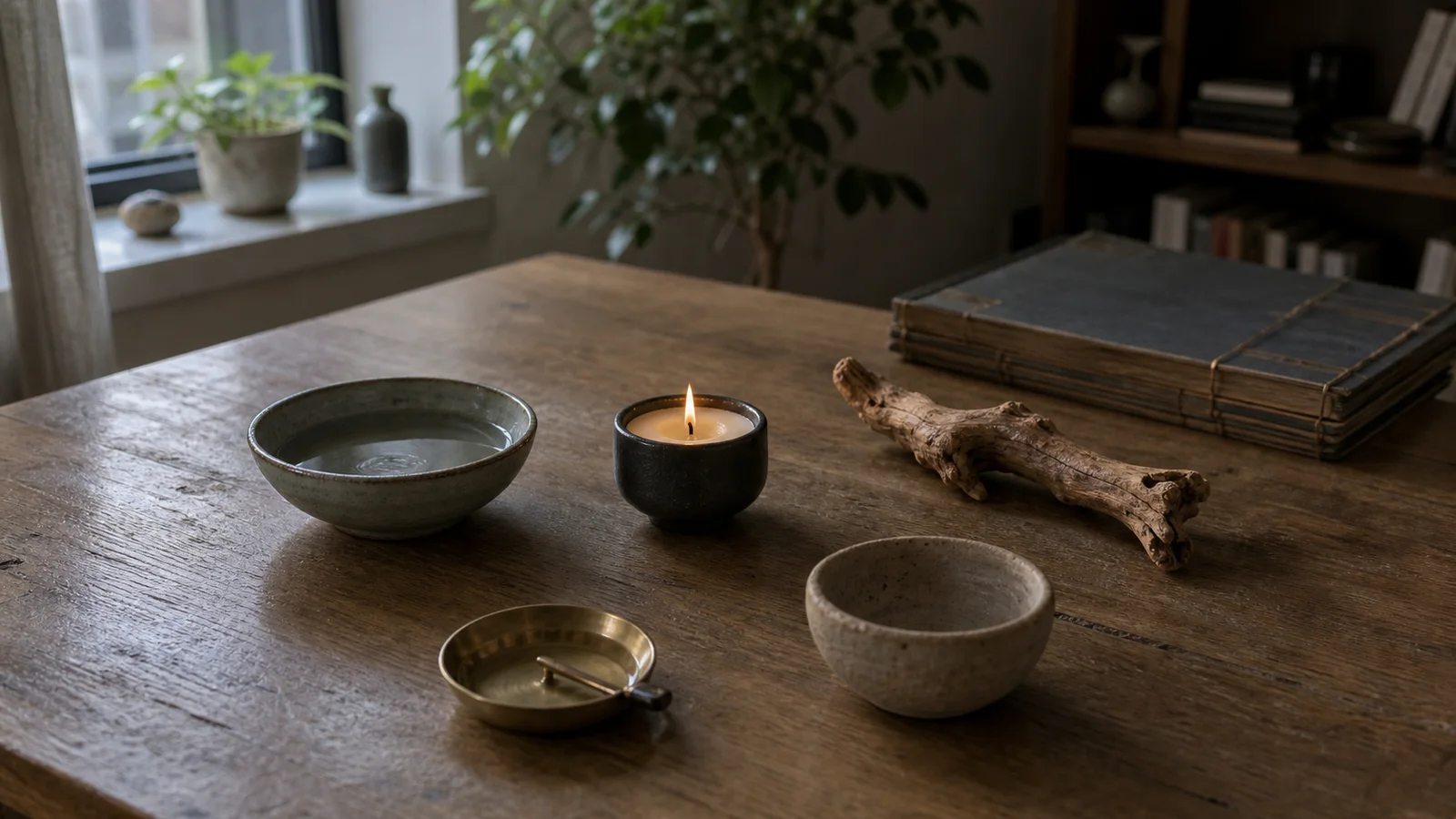
The Five Elements become easier to read through material qualities: wood, flame, clay, metal, and water as phases of movement rather than isolated substances.
The objects are cues for movement qualities, not lucky objects.
Wu Xing becomes readable through texture, temperature, weight, and flow.
A tabletop scene connects classical categories to ordinary life.
A short Chinese source context
Original text is used sparingly: to show cultural root, not to create mystery or fake authority.
五行:一曰水,二曰火,三曰木,四曰金,五曰土。
AETERA translation: The Five Phases: first Water, second Fire, third Wood, fourth Metal, fifth Earth.
This early source names the five and anchors Wu Xing in Chinese correlative thinking. The familiar Five Elements name is retained while the phase-based logic is explained.
The quote names the system; it should not be used to reduce Wu Xing to fixed personality types, lucky colors, or guaranteed outcomes.
What it means
The Five Phases are Wood, Fire, Earth, Metal, and Water. They form a Chinese pattern language for transformation, relationship, timing, behavior, and environment. Each phase describes a quality of movement rather than only a material substance.
Five Elements is the familiar English translation. Five Phases is often more precise because Xing carries the sense of movement, conduct, process, or going. This guide centers that process-based reading.
The Five Phases are often marketed as fixed personality labels. That makes them easy to share but less useful. A person, home, season, or project can carry many phase qualities at once.
Cultural Frame
Classical and later Wu Xing traditions use Wood, Fire, Earth, Metal, and Water in varied correlative systems and contexts.
The generating and controlling cycles describe relationships of support and regulation among the five.
AETERA uses growth, expression, stabilization, refinement, and restoration as modern interpretive bridges for newcomers, not as standard translations of the five names.
AETERA Modern Application
Use the phases to choose which quality you want to reduce or support in a situation.
Apply them to rooms, work rhythms, relationships, recovery patterns, and decision styles.
Translate phase insight into one concrete adjustment: add structure, reduce stimulation, create recovery, clarify direction, or build support.
Editorial Boundary
The Five Phases are not medical, psychological, or financial diagnosis.
A phase label should never be treated as destiny.
AETERA applications are voluntary reflection prompts, not inherited prescriptions or objective calibration.
Where it appears
Chinese cultural ideas are easiest to understand when their practical contexts are visible.
Feng Shui
Used to read material, color, shape, placement, and spatial mood.
Chinese medicine
Traditionally used as a correspondence system, though this site does not give medical advice.
Bazi and timing
Used to interpret symbolic patterns in Chinese time systems.
How this guide stays grounded
This guide is written as cultural translation for English-speaking readers. It gives direct definitions, Chinese terms, translation boundaries, common misunderstandings, and practical contexts before application.
Last updated on August 13, 2026 using AETERA's public editorial method: source context, translation boundaries, modern-application labels, claim checks, and a correction path.
Wu Xing (五行) is treated as a Chinese correlative pattern system. The Hong Fan chapter of the Shang Shu is one early source context for the five movement qualities.
Five Phases is used here to explain why Xing points to movement, process, and relational change; Five Elements remains the familiar English name.
This page does not treat Wood, Fire, Earth, Metal, and Water as fixed personality types, fate labels, or guaranteed outcomes.
Continue Learning
Use these next pages to move from definition into application.
How the Five Elements Work
The generating and controlling cycles explained clearly.
Use the Five Elements in Your Home
A practical application guide for rooms, flow, light, material, and recovery.
Five Phases in History and Comparison
A deeper reading of sources, translation choices, cycles, and comparisons.
Five Elements vs Five Phases
Why translation changes how people understand Wu Xing.
Common Questions
Are the Five Elements and Five Phases the same?
They usually refer to Wu Xing. Five Elements is familiar in English, while Five Phases better communicates the dynamic process logic.
What are the five phases?
The Five Phases are Wood, Fire, Earth, Metal, and Water understood through movement, relationship, and cycles. Growth, expression, stabilization, refinement, and restoration are AETERA modern interpretive bridges, not standard translations of the five.
What are the 5 elements of Chinese culture?
The five elements of Chinese culture are Wood, Fire, Earth, Metal, and Water. In Chinese they are called Wu Xing, or Five Phases, because they describe patterns of change.
How do I find my Chinese element?
A simple starting point is the element associated with your Chinese birth year, based on the Heavenly Stem. For January or February birthdays, the exact result may require the lunar new year date.
Is my Chinese element the same as my personality type?
No. A Chinese element can be used as a symbolic reflection point, but this site does not treat it as a fixed personality type or destiny.
Related Foundations
Chinese cultural systems work as relationships. One concept becomes clearer when read beside the others.
Use one bounded doorway into Wu Xing.
The Chinese Element Calculator connects a birth year to a year element for cultural learning. It does not infer personality, diagnose an imbalance, or calculate a full Bazi chart.
Use Calculator