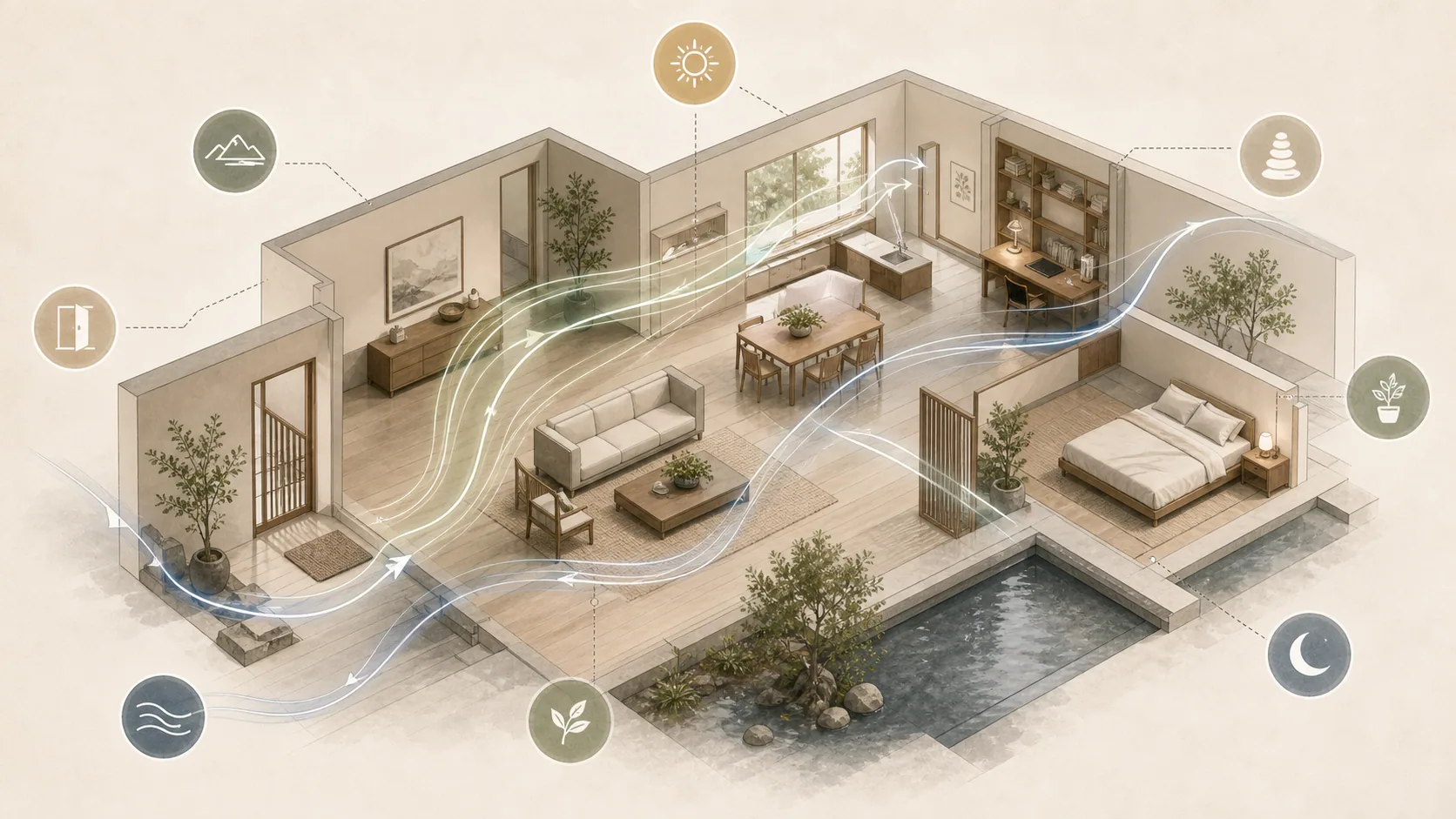
Direct Answer
Chinese Feng Shui is a varied family of Chinese spatial practices concerned with relationships among people, ancestors, land, buildings, orientation, form, wind, water, and Qi. Historical practice includes siting for burial and dwelling, while later form- and compass-oriented methods differ by school and purpose.
For modern application, AETERA uses environmental calibration as its own interpretive bridge: shaping an observable room condition so it better supports its purpose. This is not a standard translation, classical formula, or objective diagnosis.
That does not mean a sofa can control your future. It means space is not neutral. A room trains attention, emotion, habit, and recovery every day.
Source Discipline
This article explains Feng Shui in modern English while keeping the cultural boundary visible.
- Classical anchor: Feng Shui literally means wind-water and is traditionally connected to how wind, water, Qi, landform, dwelling, orientation, and burial relate.
- Traditional development: Feng Shui includes different schools and practices, including form, compass, landscape, dwelling, and timing methods. One modern guide cannot represent all lineages.
- Modern translation: "environmental calibration" is the contemporary application phrase used in this guide for translating selected spatial relationships into home, work, and ritual language. It is not a standard translation.
Chinese Cultural Root / 中国文化根基
Feng Shui is written 風水 in traditional Chinese and 风水 in simplified Chinese. Literally, it means wind-water.
That literal translation matters. Feng Shui is not originally a furniture trend or a Western interior styling method. It grows from Chinese ways of reading landform, direction, dwelling, Qi, threshold, burial, settlement, and the relationship between human life and place.
This modern phrase should not erase the Chinese root. It helps North American readers understand why Feng Shui is about relationship with place, not merely decorative taste.
Feng Shui Is Not Just Furniture Placement
Many English-language introductions reduce Feng Shui to where a bed, desk, mirror, or plant should go. Placement matters, but it is only the surface.
At a deeper level, Feng Shui asks:
- What kind of Qi does this place hold?
- Does movement through the room feel clear or blocked?
- Does the space support rest, focus, warmth, or pressure?
- Are work signals invading recovery zones?
- Does the room match the season of life you are in?
This is why Feng Shui is more than interior decoration. It is a way of reading relationship: between body and room, person and direction, daily ritual and environmental signal.
Reading Rule: Function Before Symbol
Start with what a space trains before asking what symbol it contains.
Before adding an object, ask what the room is already teaching:
- Does the entry help the body arrive, or does it immediately display unfinished work?
- Does the bedroom make recovery obvious, or does it keep output visible?
- Does the desk support one decision at a time, or does every surface compete for attention?
- Does the living room invite warmth, or does the layout make people perform for a screen?
Symbols can matter in Chinese culture, but symbols without function become decoration. A restrained Feng Shui reading begins with pathway, light, use, boundary, and repeated behavior.
This is also where many quick Feng Shui articles lose credibility. They jump straight to objects: a mirror, a plant, a coin, a color. Those may have a place in specific traditions, but they cannot replace the harder question of whether the room actually supports sleep, focus, warmth, or recovery.
Historical and Practice Layers of Feng Shui
Feng Shui is not one single checklist. A useful modern explanation needs to separate levels.
The first layer is land and form: how mountains, water, roads, wind, openings, and surrounding structure shape a place.
The second layer is dwelling and orientation: how a building receives movement, light, direction, entry, rooms, and thresholds.
The third layer is lived rhythm: how people actually sleep, work, gather, cook, recover, and make decisions inside the space.
This article focuses mostly on the third layer for modern homes, while keeping the older land-and-dwelling context visible. That is a translation choice, not a claim that all traditional Feng Shui can be reduced to lifestyle design.
That boundary is important. A serious modern Feng Shui guide should not pretend to represent every lineage, compass method, burial tradition, or professional consultation system. This article is narrower: it gives North American readers a trustworthy entry point for understanding space, Qi, function, and daily rhythm without fear marketing.
The benefit of this narrower frame is clarity. The risk would be flattening the tradition. That is why the Chinese root, the limits of the article, and the distinction between spatial reading and guaranteed outcome claims remain visible throughout.
Qi in Feng Shui
Qi is often translated as energy, but that word can become vague or misleading. AETERA uses vital rhythm as a modern interpretive bridge for the felt movement of life through a space; it is not a standard translation or scientific measurement.
In a home, Qi is affected by ordinary things:
- natural light,
- doorways and pathways,
- clutter and open loops,
- texture and material,
- sound and privacy,
- where attention repeatedly lands,
- how easily the body can move from output to rest.
You do not need to prove Qi as a scientific measurement to notice that one room calms you while another keeps you alert. Feng Shui begins with that observation.
Feng Shui and the Five Phases
Feng Shui often works with the Five Phases: Wood, Fire, Earth, Metal, and Water. These are not simply decorative themes. The following growth, expression, stabilization, refinement, and restoration language is an AETERA modern application bridge, not a set of standard translations or classical original meanings.
Wood supports growth, direction, and new movement. Fire supports light, visibility, expression, and warmth. Earth supports stability, nourishment, and holding. Metal supports clarity, boundary, and refinement. Water supports depth, quiet, restoration, and flow.
In a modern home:
- A desk may need more Metal if decisions feel scattered.
- A bedroom may need more Water if the body cannot settle.
- A living room may need more Fire if connection feels flat.
- A kitchen may need more Earth if daily life feels unanchored.
- A creative corner may need more Wood if growth feels blocked.
The point is not to decorate with symbols. The point is to understand what a space is asking for.
What Modern Feng Shui Should Avoid
Modern Feng Shui loses authority when it creates fear. One object cannot guarantee wealth, protection, love, or success.
We also avoid reducing Chinese culture to red envelopes, lucky charms, dragons, or decorative characters. Those symbols can have cultural meaning in context, but when used as shortcuts they often make Feng Shui feel less credible.
Just as important, Feng Shui should not be over-modernized until its Chinese structure disappears. If everything becomes "good vibes" or generic minimalism, the tradition has been flattened. The standard here is to translate clearly without pretending the translation is the whole tradition.
Modern Feng Shui should be:
- culturally grounded,
- visually restrained,
- practical,
- spiritually meaningful,
- clear about its limits.
A Practical Example
Imagine a bedroom that looks beautiful but does not restore you. Work clothes are visible. A laptop sits near the bed. The lighting is bright and overhead. The first thing you see in the morning is a pile of unfinished decisions.
A modern application might use Fire, Metal, and Water language to compare the room's visible cues with its intended recovery function.
The point is not that the bedroom is "bad Feng Shui" in a frightening sense. The point is that the room is asking the body to remain available. It keeps decision, visibility, and work identity alive when the room's job is restoration.
The calibration is simple:
- Remove visible work cues.
- Lower evening light.
- Use softer material and quieter color.
- Create one repeated closing ritual before sleep.
- Keep the first visible surface clear.
This is Feng Shui as daily ritual, not superstition.
Why Feng Shui Matters Now
Modern homes do more than shelter us. They hold remote work, family life, sleep, content creation, exercise, recovery, and identity. Conflicting room signals can leave work and recovery cues entangled throughout the day.
Feng Shui gives language to something many people already feel: space affects rhythm.
For North American readers, the most useful entry point is not "How do I attract luck?" but "How can my space support the person I am becoming?"
Where to Continue
For the concise definition and historical foundation, read What Is Feng Shui? Meaning, History, and Chinese Foundations. For room-by-room navigation, use the Feng Shui Application Hub. For Qi, read What Is Qi in Chinese Culture?. For the boundary between cultural practice and fear-based claims, read Is Feng Shui Superstition?.
FAQ
Is Feng Shui superstition?
Feng Shui can be presented superstitiously, but it does not have to be. This guide treats it as a varied Chinese spatial tradition; environmental calibration is explicitly modern application language used by AETERA.
What does Qi mean in Feng Shui?
Qi can include breath, vitality, atmosphere, and movement depending on context. Vital rhythm is the modern interpretive bridge defined earlier in this guide for reflecting on flow, attention, light, material, and daily use.
Do I need Feng Shui objects?
Not necessarily. Start with light, flow, boundaries, clutter, and room function before buying objects.
Is Feng Shui the same as interior design?
No. Interior design often begins with aesthetics and function. Feng Shui begins with relationship between person, place, timing, and Qi.
How can I start with Feng Shui?
Choose one room and ask what it should support: rest, focus, warmth, recovery, or decision-making. Then remove signals that contradict that purpose.