Direct Answer
Feng Shui can become superstition when it is sold as a set of fear-based rules or lucky-object guarantees. But Feng Shui itself is more accurately understood as a Chinese spatial tradition for reading how place, orientation, pathways, light, placement, material, timing, and Qi shape human experience.
Feng Shui without superstition begins with a better question:
What is this space teaching the body to feel, repeat, and expect?
That question is practical. It is also spiritual, because it treats home as a meaningful field rather than a storage container.
Source Discipline
This article does not invent a new Feng Shui lineage. It translates a traditional cultural field into careful modern language.
- Classical anchor: Feng Shui literally means wind-water. The term is traditionally linked to the Zang Shu, or Book of Burial, where wind disperses Qi and water contains or gathers it.
- Traditional development: Feng Shui includes landscape, orientation, burial, dwelling, form, compass, timing, and later popular practices. A short modern article cannot exhaust those lineages.
- Modern translation: "environmental calibration" is a contemporary English phrase for reading how space, pathway, light, material, placement, and ritual shape daily experience.
Chinese Cultural Root / 中国文化根基
Feng Shui is 風水 / 风水, literally wind-water. The phrase points to the movement and gathering of Qi in relation to land, dwelling, direction, threshold, and human use.
In traditional contexts, Feng Shui includes more than room styling. It can involve landscape form, burial sites, settlements, compass methods, dwelling orientation, time cycles, and the relationship between people and place. A modern home article cannot reproduce the full field, but it should preserve the central idea: space is relational.
That is why a non-superstitious Feng Shui explanation should not erase Chinese structure. The goal is not to turn Feng Shui into generic minimalism. The goal is to translate its concern with Qi, form, movement, timing, and dwelling into language modern readers can use responsibly.
Why People Think Feng Shui Is Superstition
Many English-speaking readers first encounter Feng Shui through simplified claims:
- Put this object here to attract wealth.
- Avoid this direction or your luck will suffer.
- Buy this symbol to fix your relationship.
- Activate this corner to guarantee success.
- Place this charm to protect your home.
Some of these ideas may come from fragments of real traditions, folk practice, or modern commercial Feng Shui. But when they are stripped of context and sold as guarantees, they make Feng Shui look like superstition.
The problem is not that objects or symbols can never matter. Objects can hold memory, attention, ritual, beauty, and cultural meaning. The problem is the claim that an object automatically controls a person's future.
That claim should be rejected.
What Feng Shui Means More Carefully
Feng Shui (風水 / 风水) literally means wind-water. It is a broad Chinese spatial tradition concerned with how people, buildings, landscapes, movement, orientation, and Qi relate to one another.
In modern language, Feng Shui asks:
- How does life move through this place?
- What does the first sightline teach the body?
- Where does attention gather or leak?
- What kind of activity does the room repeat?
- Does the space support rest, focus, care, visibility, or recovery?
- Which Five Phase qualities are overactive or missing?
This is not the same as saying a sofa controls fate. It means space has consequences. A room trains attention, emotion, habit, and recovery every day.
Environmental Calibration
For modern readers, Feng Shui can be translated as environmental calibration.
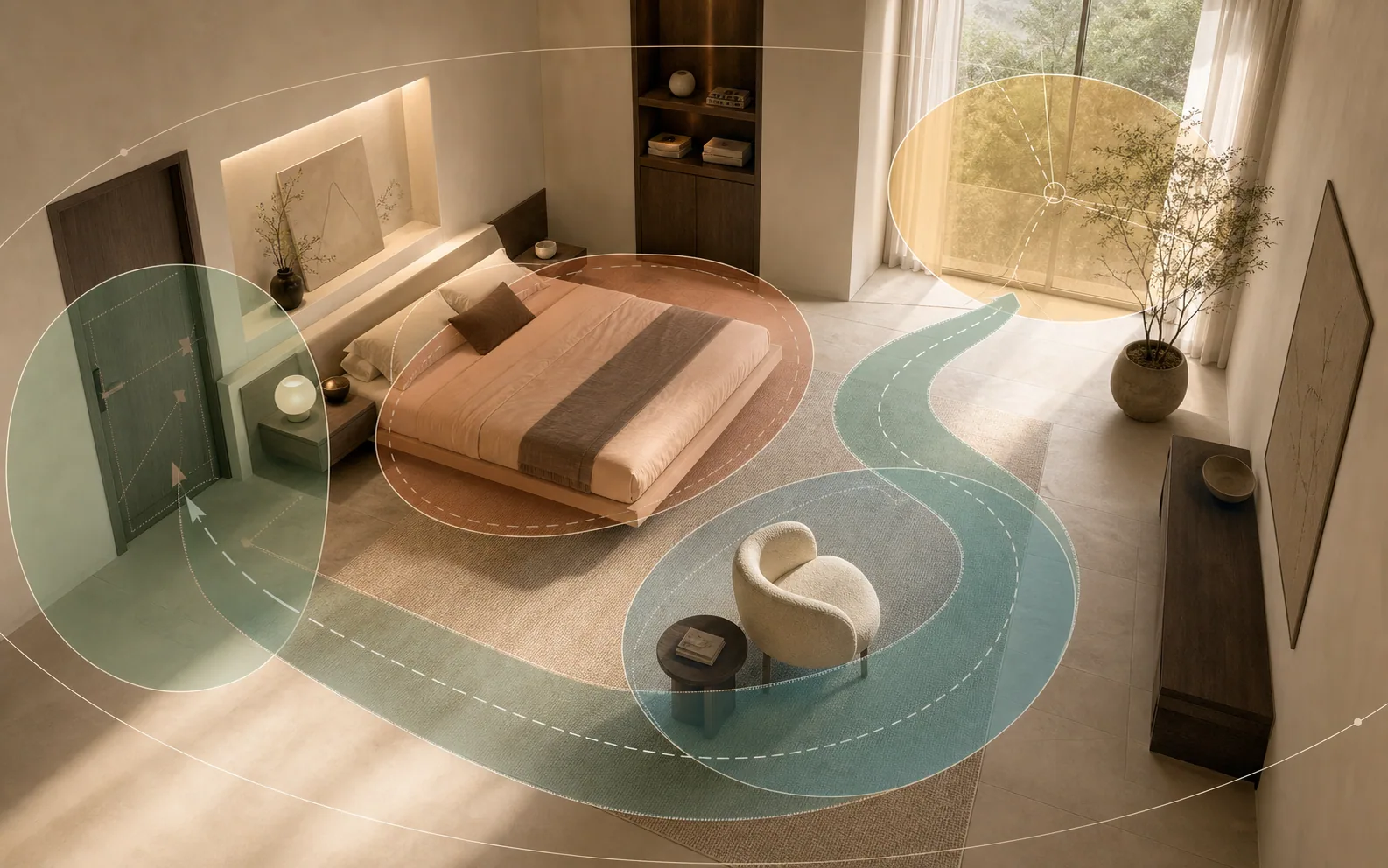
That means reading four layers:
- Flow: how the body moves through the space.
- Signal: what the room repeatedly tells the nervous system.
- Elemental balance: which Five Phases are overactive or missing.
- Ritual: what repeated action restores the room's purpose.
For example, a cluttered desk is not "bad luck." It is a field of open loops. It keeps unfinished tasks visible and trains low-grade vigilance.
A bedroom with bright overhead light, work devices, and unresolved piles is not cursed. It is over-signaled. It asks the body to recover while still displaying output demands.
This framing keeps the wisdom while removing fear.
What to Keep from Traditional Feng Shui
Modern translation should not erase cultural roots. Feng Shui carries important ideas that remain useful:
- The person and environment are connected.
- Space has movement and quality, not only shape.
- Direction and placement influence experience.
- Materials and colors carry psychological and symbolic weight.
- Timing matters.
- A home should support the life phase of the people inside it.
- Qi can be read through pathways, thresholds, light, privacy, and use.
These ideas can be used respectfully without turning them into rigid commands.
What to Remove
Avoid Feng Shui advice that depends on fear or guaranteed outcomes.
Avoid:
- "This object will make you wealthy."
- "This corner will fix your relationship."
- "This mistake will ruin your future."
- "This symbol protects you automatically."
- "This direction is always bad for everyone."
Use instead:
- "This space may be amplifying pressure."
- "This room needs a clearer recovery signal."
- "This desk needs more boundary and decision structure."
- "This entryway can become a transition ritual."
- "This object can act as an anchor for attention."
The second set of statements is more honest. It gives people agency instead of fear.
Feng Shui Without Buying Anything
The safest way to begin Feng Shui is not to buy a symbol. It is to remove contradiction.
Choose one room and ask:
- What is this room supposed to support?
- What is the first thing my body sees here?
- Where does movement feel blocked?
- Which signals contradict the room's purpose?
- What one ritual would help the room return to its role?
If the room is for rest, remove work signals. If the room is for focus, reduce visual noise. If the entryway feels chaotic, create a landing ritual. If the living room feels emotionally flat, add warmth, light, and intentional gathering.
This is Feng Shui as daily practice, not superstition.
Feng Shui and Qi
Qi is often translated as energy, but a more practical phrase is vital rhythm. In Feng Shui, Qi describes how life moves through a space and how that movement feels.
Qi is affected by ordinary things:
- entryways,
- pathways,
- light,
- clutter,
- material,
- sound,
- privacy,
- furniture placement,
- room purpose,
- repeated behavior.
This does not require a fear-based worldview. Most people can feel the difference between a room that helps them exhale and a room that keeps them half-alert.
Feng Shui and the Five Phases
The Five Phases, also called the Five Elements, give Feng Shui a more precise vocabulary.
Wood can support growth and direction. Fire can support warmth and visibility. Earth can support care and stability. Metal can support boundaries and refinement. Water can support rest and depth.
If a bedroom has too much Fire signal, it may need Water recovery. If a desk has too little Metal, it may need structure and closure. If a living room feels emotionally cold, it may need Fire warmth and Earth welcome.
The point is not to decorate with obvious symbols. The point is to ask which quality the room needs.
Why This Still Counts as Spiritual
Some people assume that removing superstition removes spirituality. That is too narrow.
Spirituality does not require fear. It can mean living with more presence, rhythm, respect, and attention.
A room can become spiritual when it helps you return to yourself. A ritual can be spiritual when it marks a transition. A material object can be spiritual when it reminds you how to behave with more clarity.
The object is not magic. The relationship is the practice.
A Practical Example
Imagine an entryway filled with shoes, unopened packages, bags, and visual clutter. A fear-based reading might say the entry blocks luck. A more grounded reading says:
The entryway is the first transition between the outside world and the home. If it repeats disorder, unfinished tasks, and blocked movement, the body enters the home through pressure.
The calibration might be:
- Clear the main path.
- Create one landing place for keys and bags.
- Remove anything that belongs to another room.
- Add one calm visual anchor.
- Make entry and exit a short ritual instead of a scramble.
No guarantee. No threat. Just a better relationship between person and place.
Where to Continue
For a stable definition, read Chinese Feng Shui Explained Clearly. For Qi, read What Is Qi in Chinese Culture?. For source and claim boundaries, read AETERA Editorial Standards and the Chinese Cultural Source Library.
FAQ
Is Feng Shui superstition?
Feng Shui can be presented superstitiously, but it is not only superstition. It can also be treated as Chinese spatial wisdom and environmental calibration without guaranteed-outcome claims.
Can Feng Shui be practiced without superstition?
Yes. Start with flow, light, boundaries, clutter, room purpose, and repeated behavior instead of fear-based rules or lucky-object promises.
Is Feng Shui only about lucky objects?
No. Objects are secondary. Flow, Qi, light, material, thresholds, privacy, movement, and daily use matter more.
Does Feng Shui guarantee wealth or love?
No. Feng Shui should not be used to guarantee wealth, love, protection, health, success, or fixed future outcomes.
What is the safest way to start?
Start by removing contradiction. If a room is for rest, remove work signals. If a room is for focus, reduce visual noise. If an entry feels chaotic, clear the path and create a landing ritual.
Does this approach reject traditional Feng Shui?
No. It respects the cultural roots while translating them carefully for modern readers who need practical, non-fear-based language.
Can Feng Shui be part of spiritual living?
Yes. Feng Shui can support spiritual living by making home more intentional, rhythmic, and attentive.