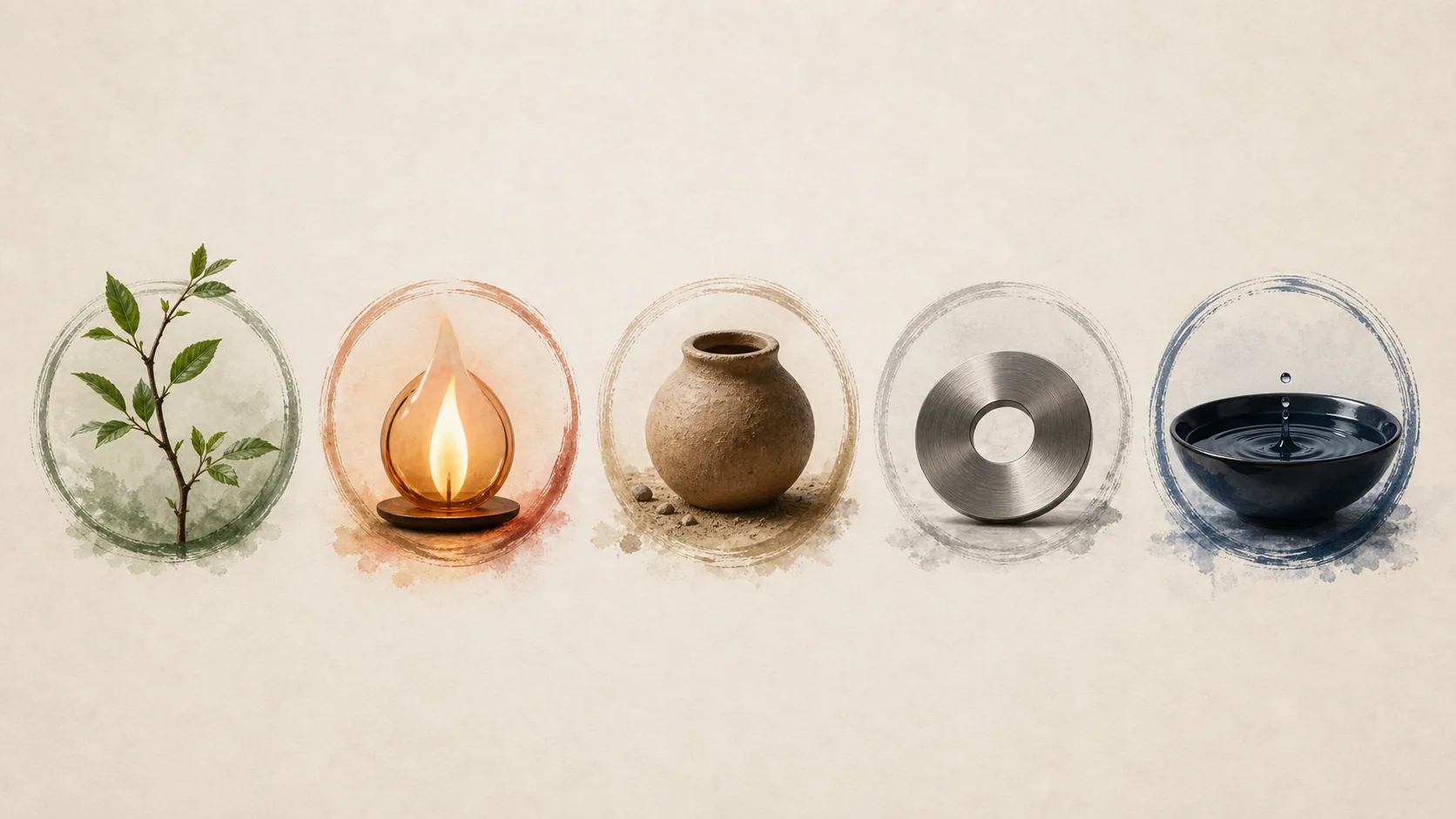
Source Discipline
This article follows three boundaries.
- Classical anchor: the Hong Fan chapter of the Shang Shu names the five as Water, Fire, Wood, Metal, and Earth and describes associated tendencies. The received text should be read in context rather than treated as a modern personality key.
- Traditional development: later Chinese traditions apply Wu Xing across cosmology, medicine, Feng Shui, calendar systems, music, governance, and symbolic correspondence.
- Modern translation: phrases such as "vital rhythm," "environmental calibration," or "movement pattern" are AETERA modern interpretive bridges for North American readers. They are not standard translations or classical formulas.
Chinese Cultural Root / 中国文化根基
Wu Xing is not a modern wellness invention. It belongs to the Chinese tradition of reading the world through patterned relationship: Heaven and Earth, season and direction, movement and restraint, support and regulation.
The Chinese term is 五行. The five are 木 Wood, 火 Fire, 土 Earth, 金 Metal, and 水 Water. The Chinese term should stay visible because the English phrase "Five Elements" is only an entry point. The deeper idea is not five substances, but five modes of change.
This is why Wu Xing connects naturally to Feng Shui, Bazi, Chinese calendar systems, traditional medicine correspondence, ritual timing, and spatial thinking. The English translation can be modern; the root remains Chinese.
Translation History: What Wu Xing Means
Wu Xing is usually written as 五行. Wu means five. Xing is harder to translate neatly. It can suggest movement, conduct, process, or going.
That is why "Five Elements" is useful but incomplete. It helps English readers find the topic, but it can make the system sound like a list of substances. Wood is not only wood. Fire is not only flame. Water is not only liquid.
As a modern interpretive bridge, this guide explains Wu Xing through processes such as:
- how growth extends,
- how activity becomes visible,
- how things stabilize,
- how form becomes refined,
- how life returns to depth and renewal.
This is the reason Five Phases is often the clearer teaching phrase. The word phase keeps the system moving.
What Makes the Theory Coherent
Wu Xing becomes confusing when the five are treated as separate personality types. The system becomes coherent when the phases are read as verbs.
Within this modern bridge, Wood grows, Fire reveals, Earth holds, Metal refines, and Water stores and restores.
The cycles then stop looking like a decorative diagram and start functioning as a grammar of relationship. One phase can support or regulate another; the meaning comes from the relationship and context rather than a permanent label.
This is the point where shallow Five Elements content usually fails. It names Wood, Fire, Earth, Metal, and Water, then turns them into traits. A stronger reading must explain relationship. If it cannot show what is supporting, what is regulating, and what practical adjustment follows, it is only vocabulary.
For a voluntary modern application, use three self-directed questions:
- What observable situation am I choosing to examine?
- Which modern phase association seems useful as a lens?
- What small, reversible adjustment do I want to try?
Without those questions, Five Elements content easily becomes a list of traits. With them, it becomes a way to read change.
A Modern Application Test
After reading about the Five Phases, a person should be able to do more than repeat the five names. They should be able to look at a room, a work rhythm, or a personal pattern and ask a more exact question.
If a bedroom is visually bright and full of devices, the useful question is not "Which object is lucky?" A reader might choose Fire and Metal associations to describe the visible cues, then compare them with Water and Earth associations linked by this modern bridge to quieter room use.
If a project has many ideas but no closure, the useful question is not "Am I a Wood person?" A reader might choose Wood, Metal, and Earth as a voluntary comparison among growth, editing, and support.
That is the difference between a glossary entry and a working cultural framework.
Modern Interpretive Glosses at a Glance
The five sections below translate selected associations into modern reflection and spatial examples. They are applications within the modern bridge defined above, not standard word-for-word translations of Wood, Fire, Earth, Metal, and Water and not inherited prescriptions.
Wood
Wood is the phase of growth. It carries the feeling of spring, planning, direction, expansion, and beginning.
In daily life, Wood appears when someone needs a new path, stronger vision, or more permission to move. In a space, Wood may be supported by upward movement, plants, flexible planning zones, clear pathways, and a sense of renewal.
When Wood is distorted, it can become pressure, impatience, overgrowth, or constant striving.
Fire
Fire is the phase of visibility and expression. It carries warmth, attention, social energy, joy, speed, and illumination.
In daily life, Fire appears through public-facing work, performance, attraction, excitement, and fast feedback. In a space, Fire may be supported by light, warmth, gathering areas, and expressive focal points.
When Fire is excessive, it can become overstimulation, burnout, drama, or inability to settle.
Earth
Earth is the phase of stability and care. It carries nourishment, responsibility, digestion, containment, and transition.
In daily life, Earth appears through routines, caregiving, meals, practical support, and the ability to hold a center. In a space, Earth may be supported by grounded materials, clear storage, soft thresholds, and places for nourishment.
When Earth is excessive, it can become heaviness, over-responsibility, stagnation, or difficulty changing.
Metal
Metal is the phase of refinement and boundary. It carries clarity, structure, standards, editing, discernment, and completion.
In daily life, Metal appears through decision-making, endings, contracts, organization, and clean limits. In a space, Metal may be supported by order, negative space, quality objects, precise placement, and defined work zones.
When Metal is excessive, it can become rigidity, criticism, emotional distance, or perfectionism.
Water
Water is the phase of depth and restoration. It carries rest, memory, privacy, strategy, wisdom, and renewal.
In daily life, Water appears through sleep, reflection, research, solitude, imagination, and long-term thinking. In a space, Water may be supported by quiet, darker tones, soft sound, privacy, and fewer visible demands.
When Water is unsupported, a person or room may feel exposed, hurried, shallow, or unable to recover.
The Generating Cycle
The generating cycle describes how one phase supports the next:
- Wood feeds Fire.
- Fire creates Earth through ash.
- Earth bears Metal.
- Metal enriches or carries Water.
- Water nourishes Wood.
This cycle is often used to understand support. In the modern bridge used here, a reader who selects visibility as a desired room quality might compare Fire with Wood associations such as direction and freshness. A reader who selects recovery might compare Water with Metal associations such as closure and boundary.
The generating cycle is not a magic formula. It is a relationship map.
The Controlling Cycle
The controlling cycle describes how one phase regulates another:
- Wood parts Earth.
- Earth contains Water.
- Water cools Fire.
- Fire melts Metal.
- Metal cuts Wood.
This cycle is easy to misunderstand. "Control" does not mean punishment. It means regulation.
In a chosen modern example, Fire can be compared with Water, Earth with Wood, Wood with Metal, Water with Earth, or Metal with Fire to think about regulation. These comparisons are prompts, not detected conditions.
In modern application, the controlling cycle can prompt a voluntary question about what kind of adjustment might support a situation. It does not diagnose an imbalance.
Five Elements in Feng Shui
In Feng Shui, the Five Elements help read the quality of a room. They can appear through material, color, shape, light, activity, sound, placement, and the behavior a space repeats every day.
A user might choose Metal associations for a home-office organization question, Water for a quieter-bedroom question, Fire for a gathering-space question, Earth for a kitchen-support question, or Wood for a creative-starting question. These are modern application examples, not prescriptions.
This does not mean every room should display obvious symbols. If a bedroom needs Water, the answer is usually not a decorative fountain. It may be less visual noise, lower light, fewer work cues, and a clearer end to the day.
Begin with practical signals:
- What does the room ask the body to do?
- What is the first thing the eye sees?
- Where does movement feel blocked?
- Which modern phase association describes a visible cue?
- Which quality do I want the room to support?
- What one reversible adjustment matches the room's purpose?
The goal is not decoration. This guide calls the practical room adjustment environmental calibration; the phrase is a modern application bridge, not a classical formula or objective correction.
Five Elements and Personality
Many people search for the Five Elements because they want to know "which element am I?" That question can be a useful doorway, but it is too narrow if treated as a final answer.
A single element should not define a person. In voluntary reflection, the same person may choose different phase associations for different situations without treating any of them as identity.
For voluntary reflection, the safer questions are:
- Which modern phase association seems relevant to the situation I selected?
- Which observable condition do I want to change?
- What small adjustment can I try without turning the result into identity or diagnosis?
Elemental language works best as reflection, not identity confinement.
Five Elements vs Western Four Elements
Western readers sometimes compare Wu Xing with the Greek or Western four elements: earth, air, fire, and water. The comparison can be interesting, but the systems are not identical.
Wu Xing includes Wood and Metal, and it does not include Air as a separate element. More importantly, Wu Xing is not simply a theory of physical matter. It is a process map. It describes how qualities generate, regulate, transform, and cycle.
Trying to force one system into the other often creates confusion. A better approach is to learn Wu Xing on its own terms.
Where Western Readers Usually Go Wrong
The first misunderstanding is that the Five Elements are literal materials only. They are symbolic anchors for movement qualities.
The second is that your element is your destiny. A phase can describe a pattern, but it should not be treated as fate.
The third is that buying an elemental object guarantees an outcome. An object may support attention or ritual, but it does not automatically create wealth, love, health, protection, or success.
The fourth is that the system is clinical science. Wu Xing should not be presented as medical, psychological, financial, or scientific diagnosis. It is better explained here as a Chinese cultural framework and practical pattern language.
There is one more subtle mistake: making the system too neat. Real life is mixed. A room can combine cues that this modern bridge associates with Fire, Metal, Earth, and Water at the same time. Wu Xing becomes useful when it helps a reader see relationship, not when it turns every person or object into a single label.
A Practical Example
Imagine someone who is productive but restless. She starts many projects, responds quickly, and appears successful, yet sleep feels thin and decisions keep looping.
As an explicitly modern reflection, someone could compare Wood and Fire associations such as growth, motion, visibility, and output with Water and Metal associations such as recovery, privacy, closure, and boundary. This is a chosen lens, not a detected condition.
This chosen comparison is not saying "she is a Wood person" or "Fire is bad." It simply separates the cues she associates with output from the cues she wants for recovery.
A modern application could be simple:
- Choose fewer public output windows.
- Add one quiet Water ritual before sleep.
- Use one Metal rule to end work cleanly.
- Keep the desk visually closed after the day ends.
The Five Elements become useful when they lead to a concrete adjustment.
Where to Continue
For the beginner list, use the Five Elements direct answer. For the translation and process guide, use the Five Phases page. To explore a birth-year element within clear calendar and identity boundaries, use the Chinese Element Calculator. For concept relationships, use the Knowledge Graph.
FAQ
What are the Five Elements in Chinese culture?
The Five Elements in Chinese culture are Wood, Fire, Earth, Metal, and Water. In Chinese, the framework is called Wu Xing, often translated more precisely as Five Phases.
What does Wu Xing mean?
Wu Xing is commonly rendered as Five Phases or Five Movements to emphasize process. Growth, expression, stabilization, refinement, and restoration are AETERA modern interpretive bridges, not standard translations of the five names.
Are Five Elements and Five Phases the same?
They usually refer to the same Chinese framework. Five Elements is the familiar English phrase, while Five Phases better captures the system's movement-based logic.
What are the generating and controlling cycles?
The generating cycle shows how phases support one another. The controlling cycle shows how phases regulate one another. Both are relationship maps, not magic formulas.
How do I find my Chinese element?
A simple starting point is the element associated with the Heavenly Stem of your Chinese birth year. January and February birthdays may require Lunar New Year correction.
Are the Five Elements a personality test?
No. Wu Xing has been used across varied Chinese fields and later practices, but this article does not infer personality, fate, compatibility, health, or product need from an element label.
Are the Five Elements scientific?
The Five Elements are not presented here as clinical science. This article provides cultural explanation and clearly labeled, voluntary modern reflection only.