Direct Answer
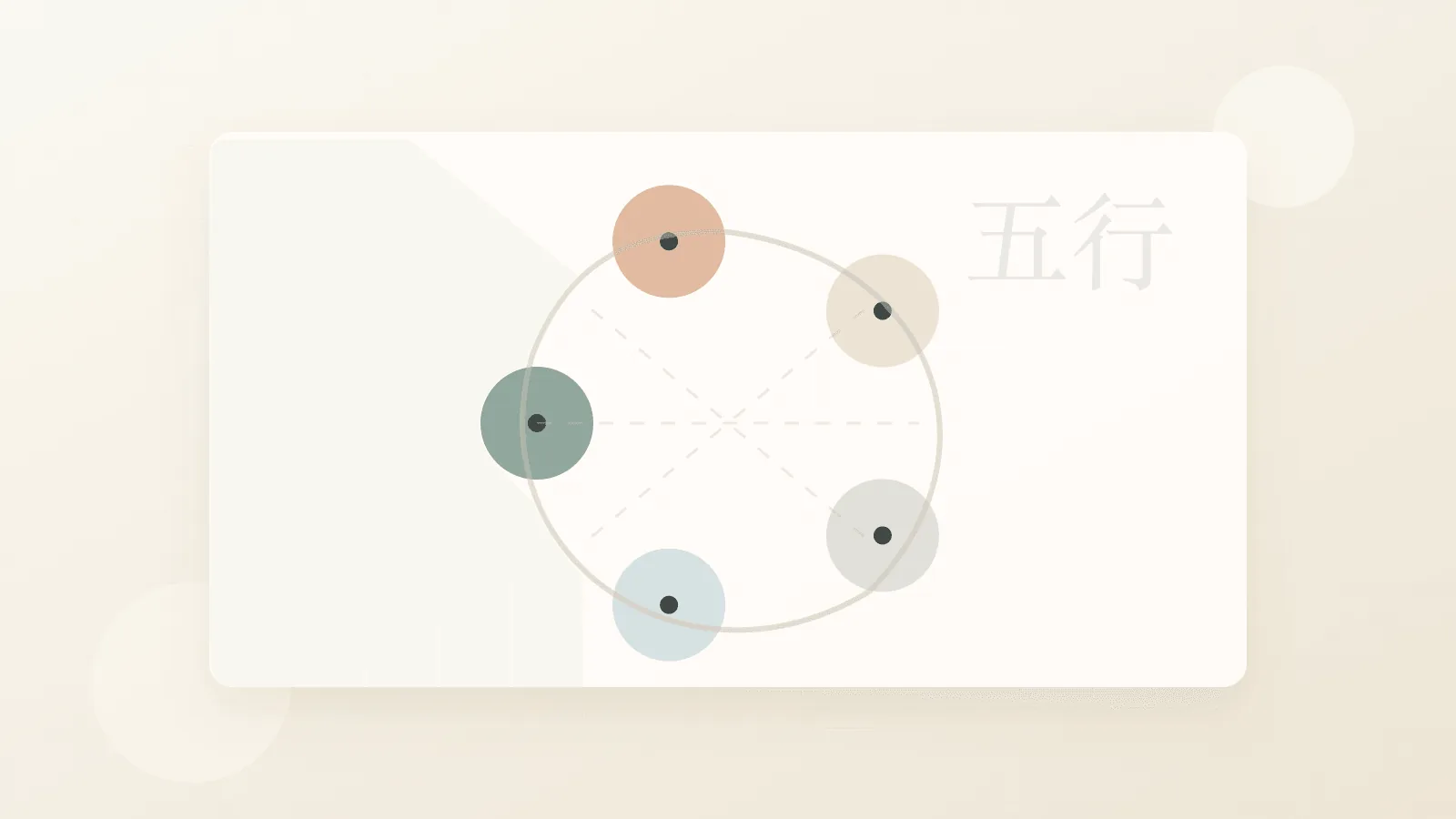
Wu Xing means Five Phases or Five Movements. It names Wood, Fire, Earth, Metal, and Water as patterns of change, not just materials. The system becomes useful when it explains how qualities support, regulate, overgrow, weaken, or restore one another.
Source Discipline
This article uses Wu Xing as a Chinese cultural framework and keeps the following boundaries.
- Classical anchor: 五行 names Wood, Fire, Earth, Metal, and Water as movement qualities and relationships.
- Translation boundary: Five Elements is the familiar English phrase; Five Phases is often more precise because the system describes process and change.
- Claim boundary: the article does not treat an element as fixed destiny, medical diagnosis, or guaranteed personality truth.
Chinese Cultural Root / 中国文化根基
The Chinese root is 五行: 木 Wood, 火 Fire, 土 Earth, 金 Metal, 水 Water. These are not only materials or personality labels. They are a Chinese way of reading growth, expression, stability, refinement, restoration, support, and regulation.
Keeping the Chinese term visible prevents the article from drifting into generic wellness or Western four-element language.
Why "Five Elements" can be misleading
In English, "element" often suggests a basic physical substance. That makes people compare Chinese Wu Xing to the Greek four elements or to fantasy-style elemental powers.
Wu Xing works differently. Wood, Fire, Earth, Metal, and Water are not mainly categories of matter. They describe how things behave in relation:
- Wood grows and reaches.
- Fire rises and illuminates.
- Earth stabilizes and holds.
- Metal refines and defines.
- Water descends, stores, and restores.
This is why both terms are useful: Five Elements for search clarity, Five Phases for conceptual accuracy.
The Chinese character 行 carries the sense of movement, conduct, going, or process. That is why "Five Phases" often communicates the logic better than "Five Elements." The point is not only what something is made of. The point is what kind of movement it carries and how that movement relates to other movements.
For English-language search, "Five Elements" must remain visible because it is the phrase people actually type. For cultural accuracy, the article must also teach why "Five Phases" is the more careful reading.
The generating cycle
The generating cycle describes how one phase supports another:
- Wood feeds Fire.
- Fire creates ash that returns to Earth.
- Earth bears Metal.
- Metal enriches or carries Water.
- Water nourishes Wood.
This cycle is not a mechanical law. It is a pattern for seeing support, continuity, and transformation.
In modern life, the same logic appears when planning supports visibility, visibility creates shared ground, shared ground allows standards, standards protect recovery, and recovery makes new growth possible.
The generating cycle is best read as continuity. One movement prepares conditions for another. It does not mean that more of everything is always better. Too much support can still create imbalance. For example, too much Wood feeding Fire can become overwork, speed, or constant visibility. A mature reading asks whether support is appropriate in amount, timing, and context.
The controlling cycle
The controlling cycle describes regulation:
- Wood parts Earth.
- Earth contains Water.
- Water moderates Fire.
- Fire softens Metal.
- Metal cuts Wood.
Control here does not mean domination. It means balance. A room, project, habit, or relationship can become unhealthy when one phase is unchecked.
For example, too much Fire may need Water's cooling rhythm. Too much Wood may need Metal's boundary. Too much Earth may need Wood's movement.
This is one of the most misunderstood parts of Wu Xing. In English, "control" can sound negative. In the Wu Xing frame, regulation is necessary. Without regulation, growth can become chaos, visibility can become burnout, stability can become stagnation, refinement can become rigidity, and rest can become withdrawal.
The controlling cycle is not a punishment map. It is a balancing map.
Where Wu Xing appears
Wu Xing appears across Chinese cultural systems, including:
- Feng Shui
- Chinese medicine
- Bazi and time systems
- seasonal thinking
- music, direction, color, and ritual correspondences
- political and cosmological theory in historical contexts
These uses are not identical. The shared value is the pattern language: a way of reading support, regulation, excess, deficiency, timing, and relationship without flattening every tradition into the same claim.
Practical use
Use Wu Xing by asking:
- Which quality is active here?
- Which quality is missing?
- Which quality is excessive?
- What would support balance without forcing it?
Examples:
- A chaotic desk may need Metal: boundaries and refinement.
- A stagnant room may need Wood: movement and growth.
- A restless bedroom may need Water or Earth: quiet and stability.
- A hidden project may need Fire: visibility and expression.
What makes this different from generic wellness language
Generic wellness language often says "balance your energy" without explaining the structure behind the advice. Wu Xing is more specific. It asks which phase is active, which phase supports it, which phase regulates it, and what kind of adjustment is appropriate.
That structure matters. It prevents the article from becoming vague inspiration. It also keeps the system from becoming superstition. A Wood adjustment is not automatically a plant. A Metal adjustment is not automatically a metal object. A Water adjustment is not automatically a fountain. The cultural logic comes first; the object comes later, if it is useful at all.
A Grounded Example
A person may have many ideas and strong momentum but no completion. In Wu Xing language, Wood and Fire may be active, while Metal is under-supported. The answer is not to suppress growth. It is to add editing, limits, and closure so growth becomes form.
This is why Wu Xing is more useful as a relationship map than as a personality label.
What this is not
Wu Xing is not a fixed personality system, a medical diagnosis, a prediction engine, or a guarantee of outcomes. It is best used as cultural pattern recognition: a way to name relationships and choose better adjustments.
Where to Continue
For the full foundation, read What Are the Five Elements in Chinese Culture?. For the cycles, read How Do the Five Elements Work?. For home application, read How to Use the Five Elements in Your Home.
FAQ
What does Wu Xing mean?
Wu Xing means Five Phases or Five Elements. It refers to Wood, Fire, Earth, Metal, and Water as patterns of change and relationship.
Is Wu Xing the same as the Five Elements?
Usually yes in English usage, but Five Phases is often more accurate because Xing suggests movement, process, and conduct rather than static matter.
How is Wu Xing used today?
It can be used to understand Feng Shui, time wisdom, personal rhythm, material choices, work patterns, and recovery needs when used with clear boundaries.