Direct Answer
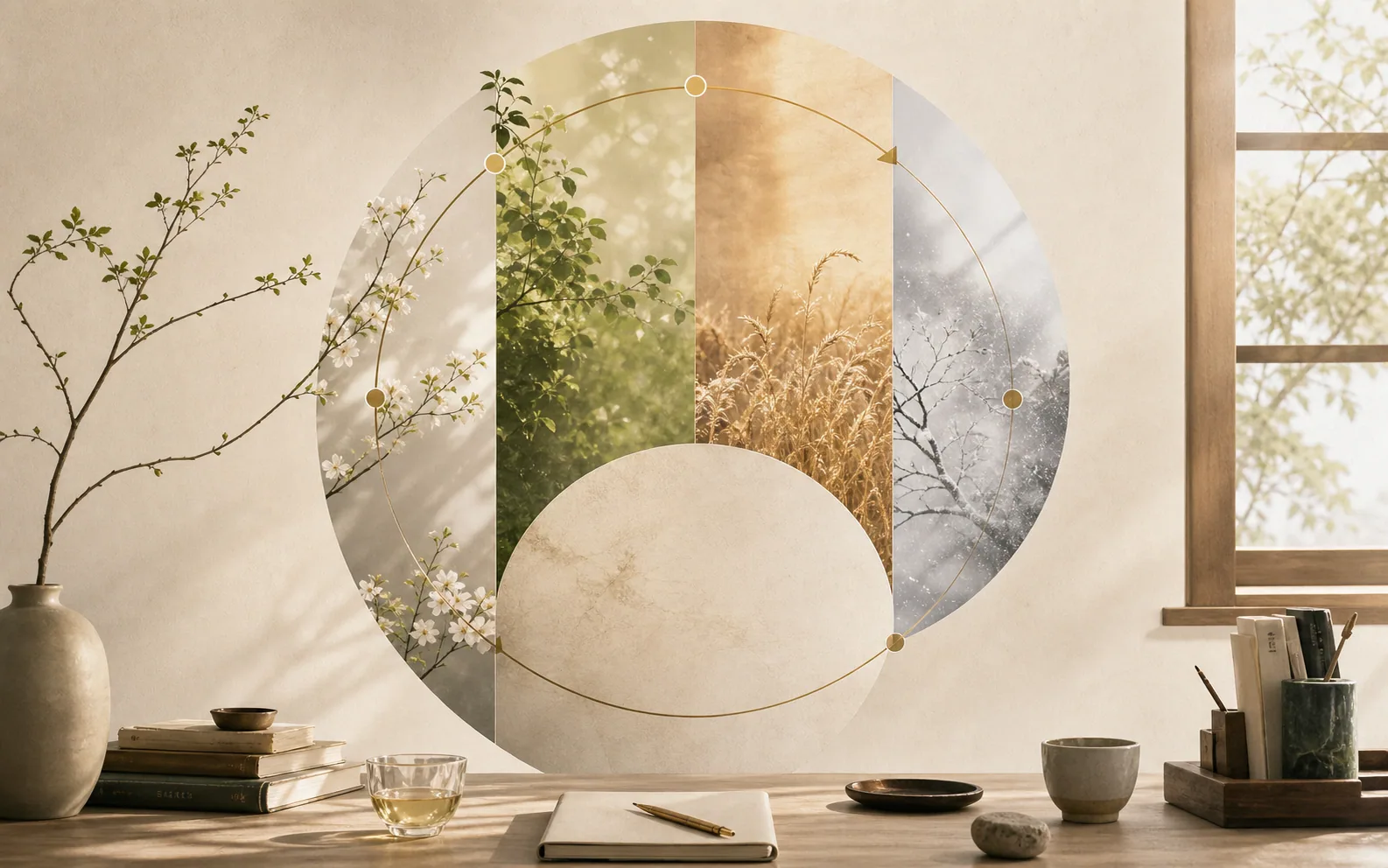
Chinese time wisdom uses cycles such as the 24 Solar Terms, Heavenly Stems and Earthly Branches, Yin-Yang, and the Five Phases to understand seasonal rhythm and timing. For modern life, it can help people plan work, rest, transitions, and rituals in ways that respect change instead of forcing constant output.
Source Discipline
This article uses Chinese time wisdom as a modern umbrella, not as one ancient school.
- Cultural anchor: the relevant systems include the 24 Solar Terms, Heavenly Stems and Earthly Branches, Yin-Yang, Wu Xing, Bazi, and later Feng Shui timing traditions.
- Translation boundary: Chinese time wisdom is a modern English umbrella category for readers; specific systems should still be named directly.
- Claim boundary: timing can guide reflection and rhythm, but it does not command fate or guarantee outcomes.
Chinese Cultural Root / 中国文化根基
The root is Chinese calendrical culture: 二十四節氣 / 二十四节气, 天干地支, 陰陽 / 阴阳, and 五行. These systems read time as patterned rather than flat.
This article translates those systems into modern rhythm language for planning, recovery, work, seasonal awareness, and ritual without turning time into a command system.
The Theory Chain
Chinese time wisdom becomes coherent when it is read as a chain rather than a collection of calendar facts.
First, Yin and Yang explain alternation: day and night, activity and rest, warming and cooling, expansion and return.
Second, Wu Xing explains movement quality: Wood begins and grows, Fire expresses and illuminates, Earth holds and integrates, Metal refines and completes, Water stores and renews.
Third, solar terms place seasonal change into a named rhythm. They help people notice whether a moment belongs to sprouting, heat, harvest, cooling, storage, or return.
Fourth, Heavenly Stems and Earthly Branches give Chinese calendar systems a repeating grammar of time. In Bazi and related traditions, this grammar becomes more personal and interpretive.
Readers do not need to memorize the whole system before using it. The practical point is simpler: timing has quality, and good action works with that quality rather than pretending every moment is identical.
The 24 Solar Terms
The 24 Solar Terms divide the year according to seasonal shifts. They emerged from agricultural observation, but their logic remains useful because human life still responds to light, temperature, growth, harvest, and rest.
A modern reader might use the solar terms to ask:
- What is this season asking me to notice?
- Am I trying to begin during a time better suited for completion?
- What should be planted, maintained, harvested, or released?
This is not nostalgia. It is rhythm literacy.
For North American readers, the solar terms should not be copied mechanically as weather advice. Local climate matters. A person in Los Angeles, Toronto, London, or Singapore may experience the same solar term through different light, temperature, work rhythm, and household needs.
The deeper value is not exact weather matching. It is seasonal attention.
How to Use Solar Terms Without Copying the Weather
The 24 Solar Terms are not a universal lifestyle script. They came from a Chinese calendrical and agricultural context, so a careful modern reader should translate the logic rather than pretend every region has the same climate.
For example, a spring solar term may not mean the same temperature in Vancouver, Phoenix, New York, and Singapore. But it can still prompt useful questions: what is beginning, what needs clearing, what is ready to grow, and what should not be forced yet?
An autumn term may not mean the same landscape everywhere. But it can still support Metal-like questions: what should be harvested, edited, completed, or released before the next cycle?
This is the difference between cultural translation and imitation. The point is not to perform a Chinese calendar aesthetically. The point is to learn from a Chinese way of noticing time as textured, seasonal, and relational.
Heavenly Stems and Earthly Branches
The Ten Heavenly Stems and Twelve Earthly Branches form a cycle used in Chinese calendrical systems. They connect time with Yin-Yang and Five Phase qualities.
For a beginner, the key point is not memorizing every combination. The key point is understanding that Chinese time systems often read time relationally: a moment is shaped by cycles, qualities, and interactions.
The full stem-branch system creates a sixty-part cycle through repeated combinations. In Bazi and related traditions, those combinations are interpreted through season, Yin-Yang, Five Phases, branch relationships, and timing cycles. This is why a responsible explanation should not reduce Chinese time wisdom to "your animal sign" or a single lucky year.
For AETERA's public content, the most useful beginner lesson is smaller and safer: time is not only a number on a calendar. It also carries pattern, sequence, and context.
Time as rhythm, not command
The wrong way to use time wisdom is to ask, "What am I allowed to do?"
The better question is, "What kind of support does this timing need?"
If a season is expansive, it still needs structure. If a season is inward, it still may need movement. If a period is pressured, it may need simplification rather than panic.
Modern applications
Chinese time wisdom can support:
- seasonal planning
- rest cycles
- project pacing
- home rituals
- review periods
- work visibility
- recovery after intense output
For example, instead of treating every week as identical, a person may design monthly rhythms:
- one week for initiation
- one week for building
- one week for refining
- one week for review and recovery
This is not a traditional formula. It is a modern application of cyclical thinking.
A Grounded Example
Imagine a founder, designer, or consultant who treats every week as a launch week. Every Monday asks for new ideas, every Tuesday asks for visibility, every Wednesday asks for client response, every Thursday asks for editing, and every Friday still asks for more output. Nothing in the calendar tells the body that a cycle has ended.
A Chinese time wisdom reading would not say, "The calendar forbids work." It would ask where the cycle is missing. Is there a Wood phase for planning before visibility? Is there Metal for closing decisions? Is there Water for recovery before the next beginning?
The practical adjustment could be small: one monthly review day, one seasonal planning ritual, one protected recovery window after a public launch, or one end-of-week closing practice. Timing becomes useful when it gives effort a shape.
Why this matters for burnout
Burnout often comes from forcing Yang output without Yin return. Chinese time wisdom gives language for alternation: activity and rest, expansion and containment, visibility and retreat.
It helps people stop treating recovery as failure.
Modern burnout often comes from treating time as infinitely available. The body receives no harvest, no storage, no winter, no completion. Chinese cyclical thinking offers a different discipline: begin clearly, build steadily, refine honestly, and return before the next cycle.
That is not mystical. It is humane timing.
What this is not
This is not a claim that traditional calendars can guarantee success. It is not a command system. It is a cultural framework for thinking about timing, seasonality, and human rhythm.
Where to Continue
For related foundations, read Heavenly Stems and Earthly Branches, 24 Solar Terms, What Are the Five Elements?, and What Is Qi in Chinese Culture?. For a time-pattern application, continue with How to Read Bazi Without Fatalism.
FAQ
What is Chinese time wisdom?
Chinese time wisdom refers to cultural systems that read time through cycles, seasons, Yin-Yang, Five Phases, stems and branches, and solar terms.
Are the 24 Solar Terms still useful today?
Yes, as a seasonal awareness framework. They can help modern readers think about rhythm, transition, and timing even outside agricultural life.
Is Chinese time wisdom fortune telling?
Not necessarily. This guide explains it as cyclical pattern language, not guaranteed prediction.
Is Chinese time wisdom one single tradition?
No. This guide uses the phrase as a modern umbrella for several Chinese systems, including solar terms, stems and branches, Yin-Yang, Wu Xing, Bazi, and Feng Shui timing traditions.
How can I use Chinese time wisdom without superstition?
Use it to ask what kind of rhythm a moment needs: beginning, support, visibility, refinement, completion, or recovery. Do not use it as a command system or a guarantee.