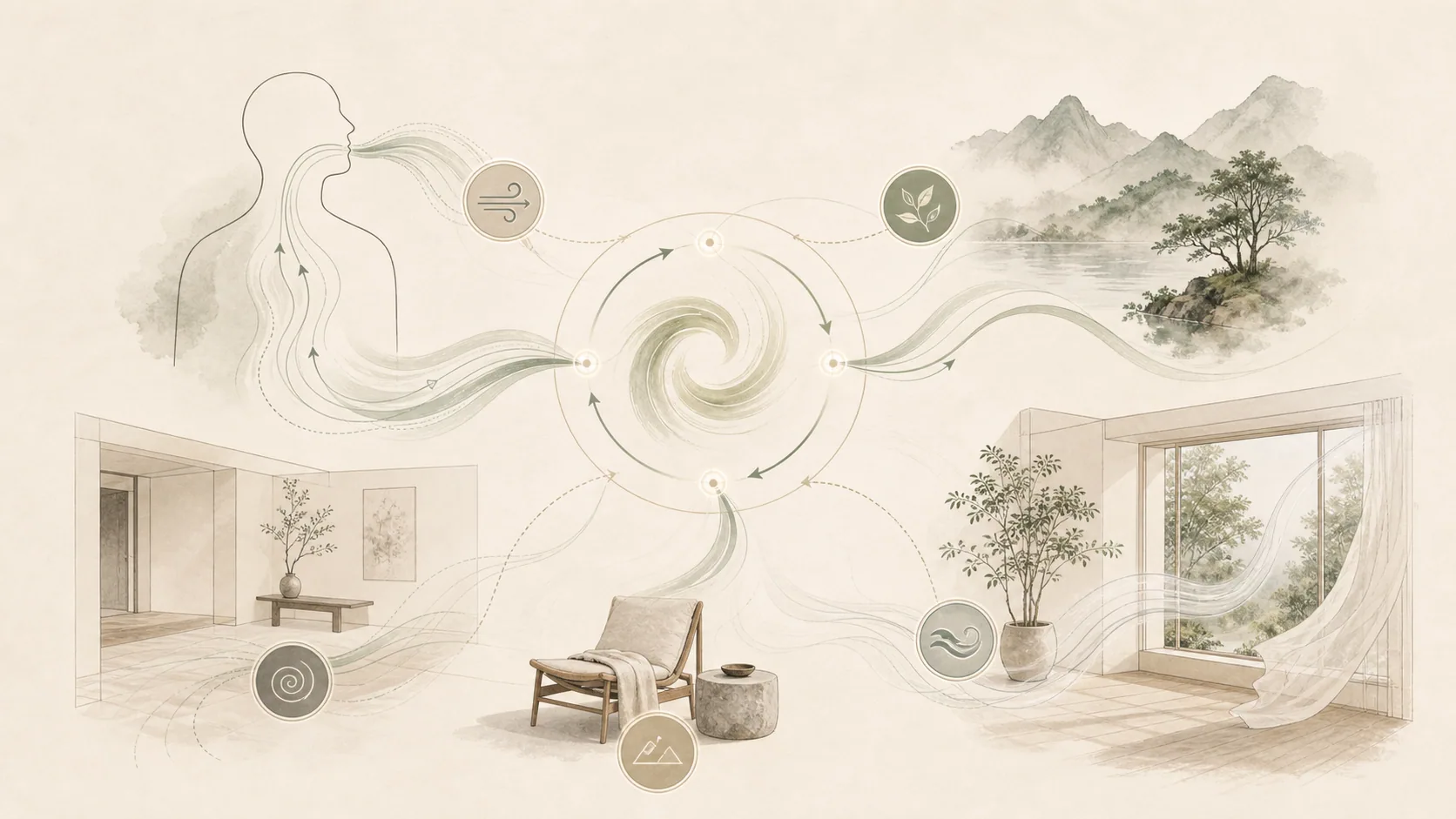
What Qi Can Describe
Qi can describe:
- the atmosphere of a room,
- the movement of breath,
- the liveliness or heaviness of a body,
- the flow or blockage of a space,
- the rhythm of a routine,
- the quality of attention in an environment.
This article does not present Qi as a medical diagnosis or laboratory measurement. It explains Qi as a Chinese cultural framework for noticing flow, pressure, recovery, and coherence.
Source Discipline
This article separates inherited concept, later practice, and modern translation.
- Classical and traditional anchor: Qi is a broad Chinese term used across philosophy, medicine, cultivation, martial arts, landscape aesthetics, and Feng Shui to describe breath, vitality, atmosphere, movement, and living quality.
- Translation boundary: "energy" is a common English translation, but it can be misleading if readers imagine one simple measurable substance.
- Modern translation: "vital rhythm" is an explanatory phrase for English-speaking readers. It helps describe flow and blockage without turning Qi into pseudoscience or medical advice.
Chinese Cultural Root / 中国文化根基
Qi is written 氣 in traditional Chinese and 气 in simplified Chinese. It is not a brand invention and not a generic wellness word borrowed for atmosphere.
Across Chinese culture, Qi can refer to breath, vitality, weather, temperament, landscape quality, bodily cultivation, and the living feel of a place. The meaning changes by context, but the concern is consistent: how life moves, gathers, disperses, becomes blocked, or becomes coherent.
This site uses "vital rhythm" as a modern English bridge. The bridge is modern; the root is Chinese.
Why "Energy" Is Not Enough
"Energy" is the most common English translation of Qi, but it creates problems. In English, energy can mean a measurable physical quantity, emotional enthusiasm, spiritual force, productivity, electricity, or vague wellness language.
That range makes Qi easy to misunderstand.
Some readers hear Qi and expect scientific proof of a single measurable substance. Other readers hear Qi and assume it is superstition. Both reactions flatten the term.
Qi is better approached as a context-sensitive cultural word. Depending on the tradition and situation, it can point toward breath, vitality, atmosphere, tendency, movement, or coherence.
The phrase vital rhythm is useful because rhythm is easier to observe:
- A room can feel rushed or settled.
- A desk can support focus or scatter attention.
- A bedroom can invite recovery or keep the mind alert.
- A schedule can create momentum or friction.
- A relationship can feel warm, blocked, sharp, heavy, or fluid.
These observations are ordinary. Qi gives them a Chinese cultural language without requiring the reader to accept a simplified English idea of "energy."
A Small Translation Test
If an explanation of Qi could be replaced by the word "vibe" without losing anything, it is probably too thin.
A stronger explanation should be able to answer: what is moving, what is blocked, what is gathering, what is dispersing, and what relationship is being described? In Feng Shui, that might be the relationship between a door, a path, a window, and a body's first response to the room. In cultivation traditions, it may involve breath, posture, and attention. In daily language, it may describe temperament or atmosphere.
The word changes by context. That is not a weakness. It is why Qi needs careful translation.
The Practical Value Test
A useful explanation of Qi should change what the reader notices. It should not only make the word sound spiritual.
After reading a good Qi explanation, a person should be able to stand in a doorway and notice the first signal of the room: where the eye goes, whether the path opens or compresses, whether the light supports the room's purpose, and whether the body wants to move, pause, work, or leave.
That does not prove Qi as a physical substance. It proves that the concept has practical value as a Chinese cultural language for relationship, movement, and felt coherence.
Qi in Chinese Culture
Qi appears across many Chinese traditions, including medicine, martial arts, calligraphy, landscape aesthetics, philosophy, ritual practice, and Feng Shui. The meaning shifts by context, but the underlying concern is relationship and movement.
In body practices, Qi may be discussed through breath, posture, vitality, and circulation. In landscape aesthetics, it may refer to the living quality of mountains, water, and composition. In Feng Shui, it often describes how life moves through a place. In daily speech and cultural metaphor, it can describe temperament, atmosphere, momentum, or spirit.
This does not mean every use of Qi is identical. A careful explanation should avoid pretending that one English word fully captures it.
Qi Is Not an Object Inside the Room
One reason Qi sounds vague in English is that people often imagine it as a hidden substance floating through a room. That is not the most useful starting point.
For practical reading, Qi is better noticed through relationship:
- the relationship between a doorway and the first visible signal,
- the relationship between a desk and the decision it asks for,
- the relationship between light and the room's purpose,
- the relationship between a body and the pace a space demands,
- the relationship between a daily habit and the environment that repeats it.
In that sense, Qi is not a thing you decorate with. It is a way to read how life is moving.
Qi in Feng Shui
In Feng Shui, Qi is closely connected to how space receives, holds, directs, and interrupts life.
Qi is affected by:
- entryways,
- pathways,
- natural light,
- clutter,
- furniture placement,
- sound,
- privacy,
- material,
- the first thing the eye sees,
- the activity a room repeats every day.
For example, an entryway crowded with shoes, bags, and unfinished errands can make the whole home feel tense before anyone consciously analyzes it. A bedroom with visible work objects may keep the body connected to output. A home office with no visual boundary may make focus feel leaky.
Feng Shui begins with this kind of spatial reading.
Three Levels of Qi Reading
A grounded Qi reading can happen on three levels.
First, there is body rhythm: breath, posture, fatigue, alertness, and recovery.
Second, there is room rhythm: entry, pathway, light, sound, visual pressure, and boundary.
Third, there is life rhythm: work cycles, family routines, privacy, social exposure, decision load, and rest.
When these levels contradict each other, people often feel it before they can explain it. A bedroom that contains work pressure, bright light, and visible unfinished tasks may still look beautiful, but it does not teach the body to release the day.
Qi and the Body
Even without treating Qi as a scientific measurement, most people can recognize changes in felt rhythm.
One room makes you exhale. Another keeps you alert. One workspace helps decisions happen cleanly. Another creates constant delay. One evening routine helps the body understand that work has ended. Another keeps the mind half-open.
This is Qi in lived experience: not a hidden object, but a way to read how a setting changes the body and attention.
This is especially useful in modern homes, where the same space may hold work, rest, social life, content, exercise, family logistics, and recovery. When too many rhythms occupy one area without boundaries, Qi becomes confusing.
Qi and the Five Phases
The Five Phases help describe different qualities of Qi.
Wood Qi feels like growth, direction, planning, and beginning.
Fire Qi feels like warmth, visibility, expression, and speed.
Earth Qi feels like holding, care, stability, and nourishment.
Metal Qi feels like clarity, boundary, editing, and decision.
Water Qi feels like depth, restoration, privacy, and strategy.
A balanced life does not need equal amounts of everything at every moment. It needs the right quality for the right context.
Qi Is Not a Shortcut for Magical Claims
Qi should not be used to claim that an object can guarantee wealth, love, protection, health, or success.
Qi should not become a fear tactic. A room is not cursed because a chair is in the wrong place. A plant does not control a person's future. A mirror does not decide someone's fate.
The more useful question is:
What signal is this space repeating, and what rhythm does that signal train?
That question keeps Qi practical.
How to Notice Qi Without Buying Anything
Choose one room and observe it for five minutes.
Ask:
- Where does my body slow down?
- Where does my attention scatter?
- What is the first visible signal from the doorway?
- What task or emotion does this room keep repeating?
- Does the light match the room's purpose?
- Is there a clear ending ritual for the activity here?
This is not about perfection. It is about reading rhythm.
A Practical Qi Reset
Use this reset when a room feels blocked, loud, or unfocused.
- Clear the main path from the door.
- Remove three objects from the first sightline.
- Close or contain one open task.
- Adjust the lighting to match the room's purpose.
- Name what the room should support: focus, rest, warmth, recovery, or transition.
If the room is for rest, reduce output signals. If the room is for focus, reduce visual noise. If the room is for connection, add warmth and a clear place to gather.
The test is not whether the room looks more "spiritual." The test is whether the room now makes the intended behavior easier.
Common Misunderstandings
The first misunderstanding is that Qi must be either proven as a single physical substance or rejected entirely. That is too narrow. This guide treats Qi as cultural language and practical observation.
The second misunderstanding is that Qi means vague mystical energy. Qi has many traditional contexts, and those contexts deserve more precision than generic wellness language.
The third misunderstanding is that Qi can be fixed by buying a symbolic object. Objects can support ritual and attention, but they do not automatically guarantee outcomes.
The fourth misunderstanding is that all Qi advice is medical advice. This article does not provide medical treatment, diagnosis, or clinical claims.
Where to Continue
For the stable topic page, read Qi Meaning in Chinese Culture. For spatial application, read Chinese Feng Shui Explained Clearly. For related concept mapping, use the AETERA Knowledge Graph.
FAQ
What does Qi mean in simple terms?
Qi can be understood as vital rhythm: the felt movement of life through body, space, breath, attention, and daily practice.
Is Qi the same as energy?
Energy is a common translation, but it is incomplete. Qi can also mean breath, vitality, atmosphere, movement, tendency, or coherence depending on context.
Is Qi scientific?
Qi is not presented here as a clinical or laboratory measurement. It is explained as a Chinese cultural framework for reading rhythm, flow, and environmental signals.
What is Qi in Feng Shui?
In Feng Shui, Qi describes how life moves through a space. It is affected by entryways, pathways, light, clutter, boundaries, material, and room function.
Can I improve Qi without buying objects?
Yes. Start with flow, light, clutter, boundaries, and room purpose before buying symbolic objects.
Is Qi medical advice?
No. This Qi guide is cultural and practical. It should not replace professional medical, psychological, ergonomic, or environmental health advice.
How does this site use Qi?
This site uses Qi to describe vital rhythm and to guide practical calibration in home, work, relationships, and recovery.