What is Bazi? Chinese Four Pillars explained without fatalism
Bazi, also called Four Pillars, uses birth year, month, day, and hour as a symbolic time structure. A useful modern reading begins with Chinese calendar literacy: Heavenly Stems, Earthly Branches, Yin-Yang, Five Phases, season, and context before any personal interpretation or chart reading.
The short answer
A concise definition with the boundaries needed to use it carefully.
Bazi (八字), often called Four Pillars, is a Chinese time-pattern system that reads birth year, month, day, and hour through Heavenly Stems, Earthly Branches, Yin-Yang, Five Phases, and seasonal context. A Bazi chart can be used as reflective cultural pattern language, but it should not be treated as a fixed prediction of fate.
Understanding birth time through four Chinese calendar pillars.
Fixed fate, fear-based choices, or guaranteed compatibility.
Notice timing pressure, support, expression, structure, and recovery.
Understand the calendar grammar
See how stems and branches form the eight characters.
Avoid fatalism
Learn how to read patterns without turning them into destiny.
Compare systems clearly
Separate Bazi from zodiac animals and Western astrology.
Start with the real question
People rarely come to this topic for trivia alone. These are the real-life questions the cultural framework can help clarify, without diagnosis or guaranteed outcomes.
You want to know whether Bazi is just fortune telling.
Bazi can be used predictively by some practitioners, but the system itself is built from Chinese calendar structure. A careful explanation starts with stems, branches, seasons, Yin-Yang, and Five Phases before making any life claim.
Treat Bazi as cultural literacy first. If a reading uses fear, certainty, or pressure, step back and ask what calendar pattern it is actually explaining.
You want a deeper self-understanding tool than a generic personality quiz.
Bazi is not a five-minute personality label. It is a relational map: year, month, day, and hour interact, and the meaning of an element changes by season and context.
Use the chart to ask better questions: what supports you, what drains you, what needs structure, what needs expression, and where recovery is missing.
You only know your zodiac animal and want to know why Bazi is different.
The zodiac animal is only one popular layer. Bazi uses four pillars, each with a stem and branch, so it is much more calendar-based than a single birth-year symbol.
Start with stems, branches, and Chinese time wisdom before accepting any full-chart interpretation.
You searched for a Bazi chart or Bazi calculator and want to know what the result means.
A chart is not self-explanatory. The useful reading comes from relationships among stems, branches, season, Five Phases, support, pressure, expression, and timing.
Do not jump from one element to a life verdict. First identify which pillar or element the calculator is showing, then read it as one part of a larger pattern.
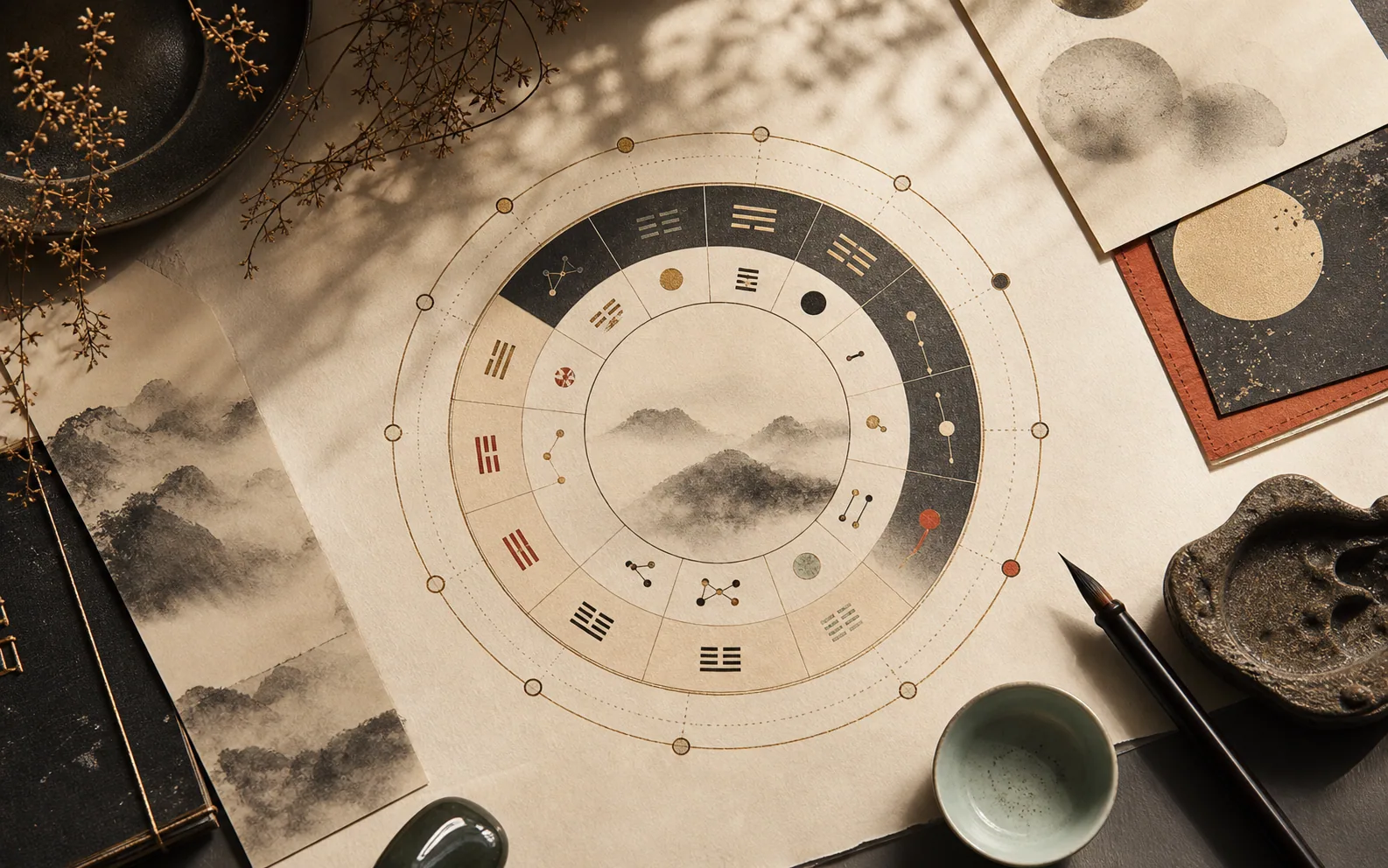
Bazi is grounded in Chinese cyclic time: stems, branches, seasons, and Five Phases, interpreted here as reflective pattern language rather than fatalism.
The chart begins from year, month, day, and hour rather than one zodiac animal.
Stems, branches, seasons, and Five Phases are the grammar underneath interpretation.
The image frames Bazi as study and reflection, not a fortune-telling spectacle.
A short Chinese source context
Original text is used sparingly: to show cultural root, not to create mystery or fake authority.
八字
Later Chinese calendrical and Four Pillars practice; the term literally means eight characters.
Eight characters.
The term points to the four stem-branch pairs for year, month, day, and hour. AETERA explains this as Chinese time-pattern language before any modern self-reflection use.
AETERA does not treat Bazi as fixed fate, guaranteed compatibility, or a substitute for professional decisions.
What it means
Bazi means eight characters. These characters come from four stem-branch pairs associated with birth year, month, day, and hour. Traditional interpretation reads relationships among Yin-Yang, Five Phases, seasonal strength, and timing cycles. The important point is relationship: one element or animal sign does not explain the whole chart.
In English, Bazi is often grouped with astrology or fortune telling. That comparison can help beginners orient themselves, but it also hides the Chinese calendar grammar behind the method. AETERA uses Four Pillars as a helpful English bridge while keeping 八字, Heavenly Stems, Earthly Branches, and Wu Xing visible.
The biggest misunderstanding is that Bazi must be used to declare destiny. A second mistake is reducing it to one element or one zodiac animal. This site does not use Bazi that way. We frame it as a cultural map for pattern, tendency, timing, support, and self-reflection.
Cultural Frame
Bazi depends on Chinese calendar logic, not only personality archetypes or zodiac animals.
The Four Pillars are year, month, day, and hour; each pillar contains a Heavenly Stem and Earthly Branch.
The Five Phases help interpret movement quality, resource, expression, structure, pressure, and support.
Seasonal timing matters because an element changes meaning depending on strength, context, and relationship.
AETERA Modern Application
Use Bazi-inspired language to reflect on recurring patterns in work, relationships, vitality, and space.
Avoid fixed verdicts; translate insight into practical questions: what needs support, structure, expression, recovery, or better timing?
Pair Bazi with the Five Phases to understand imbalance, support, and timing without fear.
Use the framework as a conversation with your life, not a command that overrides judgment.
Editorial Boundary
This site does not use Bazi to guarantee future events.
Bazi should not be used for fatalistic judgment, discrimination, or fear-based decisions.
A simplified year element, zodiac animal, or online calculator is not a full Bazi chart.
The framework is reflective and cultural, not a substitute for professional, medical, legal, financial, or mental health advice.
Where it appears
Chinese cultural ideas are easiest to understand when their practical contexts are visible.
Cultural literacy
Explains how Chinese time can be read through stems, branches, season, Yin-Yang, and Five Phases.
Self-reflection
Names tendencies, pressure points, support patterns, and recurring rhythms without turning them into destiny.
Modern ritual design
Translates symbolic pattern language into practical questions about work, home, vitality, relationships, and recovery.
How this guide stays grounded
This guide is written as cultural translation for English-speaking readers. It gives direct definitions, Chinese terms, translation boundaries, common misunderstandings, and practical contexts before application.
Last updated on August 13, 2026 using AETERA's public editorial method: source context, translation boundaries, modern-application labels, claim checks, and a correction path.
Bazi (八字) belongs to Chinese calendrical and symbolic pattern-reading traditions built around year, month, day, hour, stems, branches, and Five Phases logic.
AETERA explains Bazi as Four Pillars or eight characters, then separates cultural pattern reading from prediction certainty.
This page does not treat Bazi as fixed fate, guaranteed compatibility, or a substitute for professional life decisions.
Continue Learning
Use these next pages to move from definition into application.
Is Bazi Fortune Telling?
A careful explanation of Bazi without fatalism.
How to Read Bazi Without Fatalism
A practical standard for interpreting patterns without fear.
Heavenly Stems and Earthly Branches
The calendar grammar behind the eight characters.
Chinese Zodiac vs Bazi vs Western Astrology
A clear comparison for English-speaking readers.
Common Questions
What does Bazi mean?
Bazi means eight characters. It refers to a Chinese time-pattern system built from four stem-branch pairs: birth year, month, day, and hour.
What is a Bazi chart?
A Bazi chart is a Four Pillars chart built from the year, month, day, and hour of birth. Each pillar contains a Heavenly Stem and Earthly Branch.
Is Bazi fortune telling?
It can be used that way by some practitioners, but this site frames Bazi as reflective cultural pattern reading, not guaranteed prediction.
Is Bazi the same as Chinese astrology?
Chinese astrology is a common English comparison, but Bazi is more specifically a Four Pillars system based on Heavenly Stems, Earthly Branches, Yin-Yang, Five Phases, and seasonal context.
Is Bazi the same as the Chinese zodiac?
No. The zodiac animal is mainly tied to the year branch. Bazi uses year, month, day, and hour, so it is broader than a single animal sign.
Can Bazi tell me exactly what will happen?
AETERA does not use Bazi for exact fate claims. We explain it as cultural pattern language that can support reflection, timing awareness, and practical questions.
Related Foundations
Chinese cultural systems work as relationships. One concept becomes clearer when read beside the others.
Keep calendar structure separate from life verdicts.
Read how Bazi can be discussed without fatalism before moving from calendar structure into any personal interpretation.
Read Without Fatalism