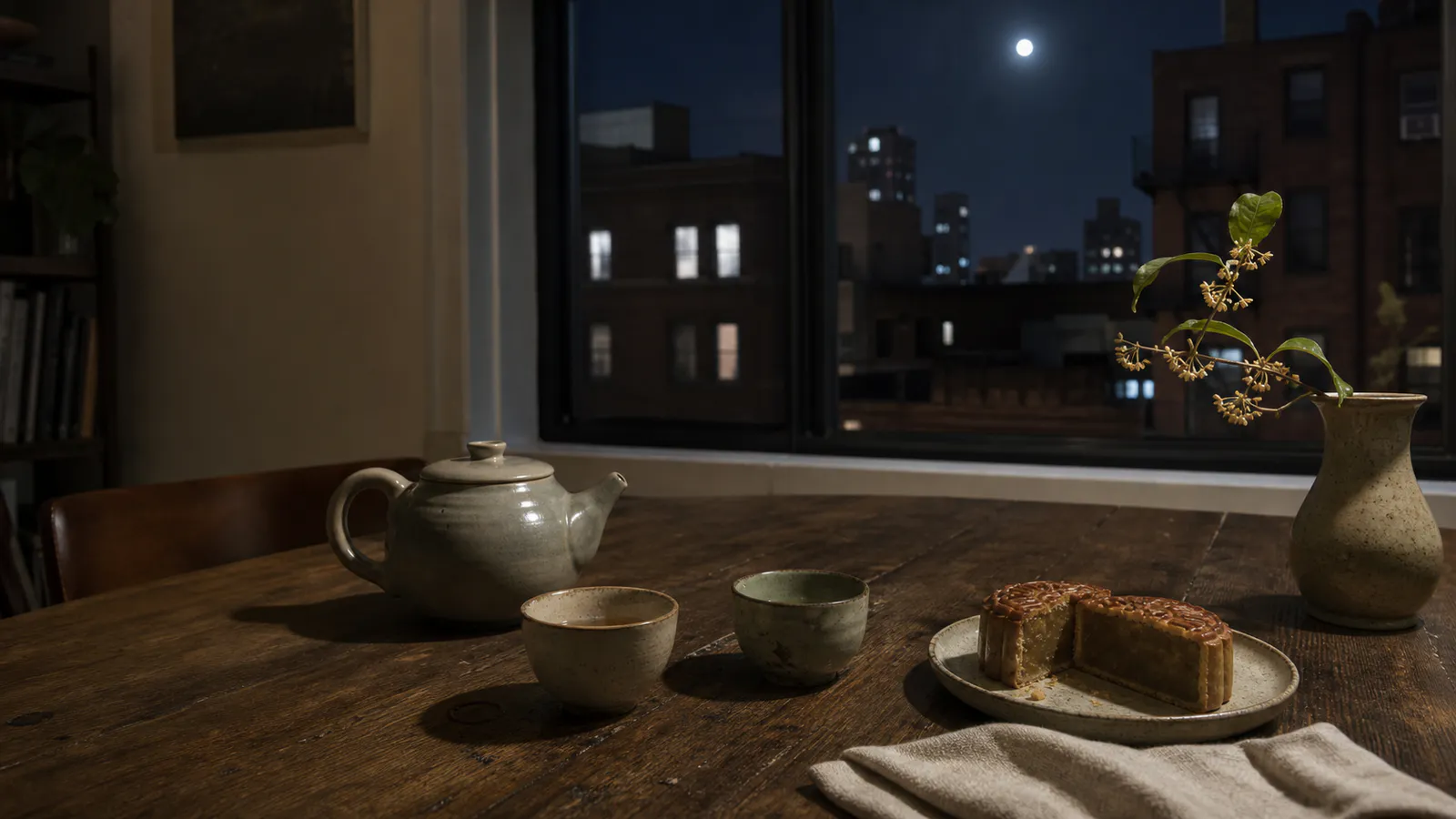
The 2026 Date, Precisely
The Hong Kong Observatory's 2026 Gregorian-lunar conversion table places the fifteenth day of the eighth lunar month on Friday, September 25. China's 2026 national holiday notice, published in English by the Beijing municipal government, lists a Mid-Autumn holiday from September 25 through September 27.
Those are related facts, not interchangeable ones:
- Festival date: September 25, 2026
- Traditional calendar date: eighth lunar month, fifteenth day
- Public holiday in mainland China: September 25-27, 2026
- Day of the week: Friday
The festival date follows the Chinese lunisolar calendar and therefore moves within the Gregorian calendar. The public-holiday schedule is an administrative arrangement and does not define how people outside mainland China take time off. A family in Vancouver may celebrate on Friday evening; a community center in Chicago may hold its event on Saturday; relatives in different time zones may arrange a video call when everyone is free. These are practical adaptations, not errors in the calendar.
For the wider relationship between lunar months, solar terms, and seasonal time, see Chinese Time Wisdom. The 24 Solar Terms are a solar system and should not be confused with the lunar date used for Mid-Autumn.
What Zhongqiu Means
中秋 literally points to the middle of autumn. In the traditional three-month seasonal sequence, the eighth lunar month occupies the middle position, and the fifteenth day is its midpoint. Adding 节 (jié) makes Zhongqiu Jie, the Mid-Autumn Festival.
The name keeps the festival inside a Chinese calendar before it introduces any particular food or story. That matters because English labels change the frame:
- Mid-Autumn Festival is the closest established translation of Zhongqiu Jie.
- Moon Festival highlights moon viewing and lunar imagery.
- Mooncake Festival foregrounds the food most readily recognized abroad.
All three English names are understandable. Only the first preserves the seasonal structure of the Chinese name. Calling it the Moon Festival can also create confusion with other Asian moon-viewing festivals that have their own histories and names.
Reunion Is a Relationship, Not a Slogan
The round autumn moon and round foods have long made an effective language for completeness. In modern festival life, 团圆 often appears in family meals, gift boxes, travel plans, and messages sent to relatives who cannot come home. A Xinhua report carried by the Chinese central government's official website describes the festival as a time when families come together, admire the full moon, share mooncakes, and mark the harvest season.
Reunion, however, is not a claim that every household is harmonious. It can be joyful, formal, complicated, or impossible. Migration, work schedules, estrangement, bereavement, intermarriage, and distance all shape the evening. Some people return to a large ancestral home. Others share one mooncake with roommates. Some remember a family member who is absent. Some do not observe the festival at all.
This range is part of the subject. An account that says "Chinese families reunite" captures a major ideal but turns an aspiration into a universal biography. A more exact sentence is: Mid-Autumn gives many Chinese families and communities a culturally recognized time to express reunion, attachment, and longing.
The difference becomes especially visible in diaspora life. The same full moon can connect relatives on opposite sides of the Pacific, yet the actual call may happen under two different skies and on two different calendar days. The old poetic association between moonlight and distant loved ones remains legible precisely because separation has not disappeared.
Why Mooncakes Matter
A 月饼 (yuèbǐng) is a mooncake: a filled pastry made in many regional styles and shared around Mid-Autumn. Roundness readily supports the symbolism of completion, but the food's social life is as important as its shape. Mooncakes are divided into portions, exchanged between households and workplaces, carried across cities, mailed to relatives, and presented in boxes whose formality ranges from modest to extravagant.
There is no single standard mooncake. A China Daily article republished by the Shaoxing municipal-government portal describes Cantonese versions with a thin, tender crust and fillings such as lotus seed paste, sweet bean paste, or nuts, while Suzhou-style mooncakes use flaky layered pastry. Suzhou versions can be sweet or savory. Other regions have their own doughs, seals, sizes, and preferences; chilled "snow skin" versions and contemporary flavors add more recent layers. A supermarket shelf in Los Angeles or Toronto may place several of these traditions beside chocolate, tea, fruit, or low-sugar variations.
The Hong Kong Education Bureau's Mid-Autumn learning material uses mooncakes, fruit, lanterns, family dinner, and moon viewing to describe a recognizable Hong Kong celebration. It documents one regional pattern rather than a universal checklist.
Moon Viewing: Attention Shared Across Distance
赏月 (shǎngyuè) means appreciating or admiring the moon. The act can be ceremonial, social, literary, or casual. People may sit outdoors after dinner, walk through a lantern display, pour tea, read a poem, or glance upward between other obligations. The moon is both an object in the sky and a cultural image shaped by centuries of writing and visual art.
In 2026, the astronomical full moon does not occur on the Gregorian festival date. The U.S. Naval Observatory's lunar-phase table places the full moon at 16:49 UTC on September 26, one day after Mid-Autumn Festival. The festival remains September 25 because its calendar date is lunar 8/15; it is not reset to the instant of astronomical full moon.
This helps explain why Mid-Autumn imagery can travel. A person does not need a flawless moonrise to understand the gesture of looking toward something also visible to distant family. The action makes separation perceptible without pretending to erase it.
Where Chang'e Belongs
嫦娥 (Cháng'é) is the best-known moon figure associated with Mid-Autumn. In widely told versions, the archer 后羿 (Hòuyì) receives an elixir of immortality, Chang'e drinks it under differing circumstances, and she ascends to the moon. A rabbit and an osmanthus tree often appear in the lunar world. Details change across texts, periods, performances, and children's retellings.
The legend is neither a scientific explanation of the moon nor a single documented founding event for the festival. It is a body of stories that became closely joined to autumn moon culture. The material record shows how durable that imagery became. A Tang-dynasty bronze mirror at The Metropolitan Museum of Art depicts Chang'e with lunar companions; a Ming-dynasty brocade panel identifies her through rabbits and an osmanthus branch. These objects do not prove one origin story. They show the legend moving through Chinese visual culture across centuries.
Telling the story responsibly means naming it as legend and allowing its variants to remain variants. It also means resisting the temptation to make Chang'e the whole festival. Family tables, seasonal foods, local lantern traditions, moon poetry, and ordinary acts of return do not depend on one narrative.
Why "Chinese Thanksgiving" Is Too Simple
North American writers sometimes call Mid-Autumn "Chinese Thanksgiving." The comparison can quickly signal autumn, food, family gathering, and gratitude. It can also flatten both occasions.
Mid-Autumn follows a lunisolar date, is organized around the autumn moon, and carries Chinese histories of moon observance, reunion, seasonal offering, poetry, and legend. Thanksgiving in the United States and Canada has different calendars, civic histories, religious inheritances, national narratives, and contemporary debates. Neither festival is an interchangeable version of the other.
Use the comparison as a temporary bridge, if needed: "Like Thanksgiving, Mid-Autumn often brings families together for a seasonal meal." Then cross the bridge and explain Zhongqiu on its own terms.
How to Participate in North America
Participation begins with identifiable people and institutions rather than an improvised "ancient" ritual. A Chinese bakery may label Cantonese, Suzhou, Hong Kong, or another mooncake style; those labels offer a useful opening for asking about crust, filling, and regional taste. Because mooncakes are dense and commonly portioned, sharing one is often more informative than buying a large decorative box without knowing what it contains.
Museum, library, university, and Chinese community-organization calendars are practical places to look for public programs. Their event descriptions should identify whether the focus is lantern making, food, music, storytelling, language, or a particular regional tradition. A Vietnamese Tết Trung Thu or Korean Chuseok program should be approached through its own name and history, not relabeled as a Chinese Mid-Autumn event.
Within a family, the most reliable guide is family memory: ask whether the date was observed, which foods appeared, and whether migration changed the practice. Without that inheritance, learning Zhongqiu's name, sharing food from a clearly identified tradition, attending a community-led program, or viewing the moon with an understanding of the calendar are all proportionate ways to engage.
The Festival Beyond a Perfect Family Picture
Mid-Autumn imagery favors circles, full tables, warm lanterns, and people returning home. Those images carry a real cultural ideal. They can also exclude anyone whose life does not match them.
A mature reading leaves space for grief and distance. A round moon can mark someone missing from the table. A gift can maintain a professional relationship rather than intimate affection. A community event can provide belonging for students and recent immigrants who cannot travel home. Reunion may be physical; it may also be remembered, attempted, or deferred.
This is not a modern correction imposed on an old festival. Longing for absent people is already embedded in Chinese moon poetry and the language of Mid-Autumn. Completeness matters because lives are often incomplete.
Cultural Boundary
Mid-Autumn customs can hold religious, familial, literary, or personal meaning, but they do not guarantee harmony, luck, health, or material outcomes. Practices differ across mainland China, Hong Kong, Taiwan, Southeast Asia, and diaspora communities; related festivals elsewhere in Asia should be named through their own traditions rather than treated as copies.
To compare another seventh-month festival shaped by reunion language, read Qixi Festival 2026. For a different kind of family and ancestral observance, see Chinese Ghost Month 2026.
FAQ
When is the Mid-Autumn Festival in 2026?
The Mid-Autumn Festival falls on Friday, September 25, 2026. Its traditional date is the fifteenth day of the eighth lunar month.
Is Mid-Autumn Festival the same as the Moon Festival?
Moon Festival is a common English name for Mid-Autumn Festival. It highlights moon viewing, but Zhongqiu Jie also includes seasonal time, reunion, food, legend, poetry, and regional customs.
Why do people eat mooncakes at Mid-Autumn Festival?
Mooncakes are a customary festival food shared and exchanged among families, friends, and colleagues. Their round form is widely associated with completeness and reunion, although recipes and meanings vary by region and household.
What does Zhongqiu Jie mean?
中秋节 (Zhōngqiū Jié) means Mid-Autumn Festival. Zhongqiu refers to the middle of autumn in the traditional calendar, and jie means festival.
Is Mid-Autumn Festival Chinese Thanksgiving?
No. The comparison can introduce the shared themes of an autumn meal and family gathering, but the festivals have different calendars, histories, symbols, and cultural settings.
Who is Chang'e in the Mid-Autumn Festival?
Chang'e is a moon figure in Chinese legend. Stories of her ascent to the moon became closely associated with Mid-Autumn culture, but versions differ and the legend is only one layer of the festival.
Sources and further reading
- Hong Kong Observatory: Gregorian-Lunar Calendar Conversion Table of 2026
- Beijing Municipal Government: 2026 Public Holidays
- Xinhua via the Chinese Government Website: Mid-Autumn Celebrations Across the World
- Hong Kong Education Bureau: Mid-Autumn Festival
- China Daily via Shaoxing Municipal Government: Regional Mooncake Styles
- U.S. Naval Observatory: Dates of Primary Phases of the Moon, 2026
- The Metropolitan Museum of Art: Mirror with Moon Goddess and Rabbit
- The Metropolitan Museum of Art: Panel with the Moon Goddess and Attendants