Direct Answer
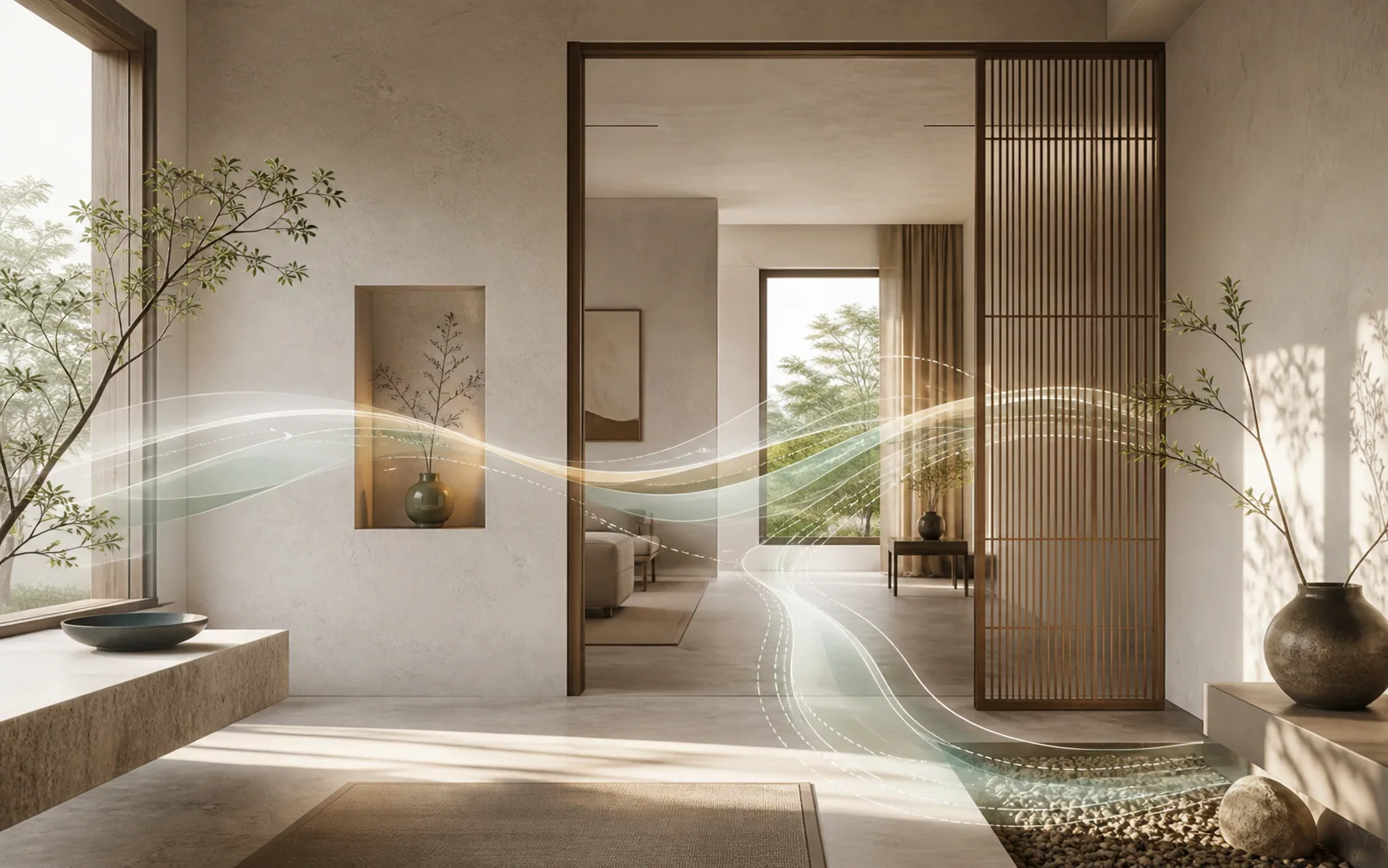
In Feng Shui, Qi refers to the living movement or vital rhythm of a space. It is shaped by entryways, pathways, light, air, clutter, material, privacy, sound, and repeated behavior. It should not be reduced to lucky objects, guaranteed outcomes, or vague supernatural claims.
Source Discipline
This article explains Qi as Chinese cultural language, not as a medical or laboratory claim.
- Cultural anchor: 氣 / 气 can refer to breath, vitality, atmosphere, tendency, movement, and living quality across Chinese traditions.
- Translation boundary: energy is common but incomplete; vital rhythm is used here as practical English explanation.
- Claim boundary: this article does not diagnose a person or a home, and it does not claim an object can guarantee healing or success.
Chinese Cultural Root / 中国文化根基
Qi is written 氣 in traditional Chinese and 气 in simplified Chinese. It appears across Chinese philosophy, cultivation, martial arts, medicine, landscape aesthetics, and Feng Shui.
This article uses Qi to help readers notice how life moves through body, room, attention, and routine. The modern language is interpretive; the cultural root is Chinese.
Why "Energy" Is Not Enough
The English word energy can be useful, but it can also become too broad. People may imagine something mystical, measurable, or supernatural. That is not the most helpful starting point for modern Feng Shui.
Vital rhythm is easier to observe.
Ask:
- Does the room breathe?
- Can the body move easily?
- Does the light support the room's purpose?
- Are there too many unfinished signals?
- Does the space invite rest, focus, warmth, or pressure?
Those questions make Qi practical.
Qi Moves Through Pathways
In a home, Qi follows movement. Doorways, hallways, furniture placement, and open floor area all influence how a person enters, pauses, turns, and settles.
When pathways are cramped, Qi can feel interrupted. When a room has no visual rest, Qi can feel scattered. When furniture blocks natural movement, the body receives friction before the mind names it.
This does not require fear-based language. A blocked path is not a curse. It is a repeated spatial interruption.
Qi Is Shaped by Light
Light is one of the clearest ways to understand Qi.
Morning light can help a room feel awake and directional. Warm evening light can help the body move toward rest. Harsh overhead light in a bedroom can keep the room in output mode. A dark work area can lower Wood movement and make initiation harder.
Feng Shui reads light as more than brightness. Light is signal.
Qi and the Five Phases
The Five Phases help describe the quality of Qi:
- Wood Qi feels upward, growing, directional.
- Fire Qi feels bright, visible, expressive.
- Earth Qi feels stable, nourishing, held.
- Metal Qi feels clear, defined, refined.
- Water Qi feels quiet, deep, restorative.
A room may have too much of one quality or too little of another. A home office may need more Metal clarity. A bedroom may need more Water. A family room may need more Earth and Fire. A creative space may need Wood.
The goal is not to make every room equal. The goal is to match Qi to purpose.
Qi Is Also Behavioral
Qi is not only what the room contains. It is also what happens there.
A dining table used for meals, bills, laundry, and work calls carries mixed signal. A bedroom used for sleep and email carries mixed signal. An entryway that catches every unresolved object becomes a daily emotional threshold.
Modern Feng Shui asks: what behavior is the space rehearsing?
This is why ritual matters. A ritual closes a loop and teaches the space its role.
A Simple Qi Audit
Choose one room and stand at the entrance.
Notice:
- Where does your eye go first?
- Where does your body want to move?
- What feels unfinished?
- What feels too bright, too heavy, too cold, or too crowded?
- What one object or signal contradicts the room's purpose?
Then make one change:
- clear the first visible surface,
- open a pathway,
- soften light,
- move work objects out of a recovery zone,
- add one material that supports the room's elemental purpose.
Qi Without Pseudoscience
Qi should not be presented as a clinical measurement. In this guide, it is cultural and experiential language for the way spaces feel, move, and influence daily rhythm.
That makes the concept more useful, not less meaningful. You do not need to prove a room's Qi to notice that your attention changes when the room changes.
Where to Continue
For the full foundation, read What Is Qi in Chinese Culture?. For the wider spatial frame, read What Is Chinese Feng Shui?. For related concepts, read Yin and Yang Meaning in Daily Life.
FAQ
What does Qi mean in Feng Shui?
Qi means the living movement or vital rhythm of a space. It can be felt through flow, light, material, layout, and repeated behavior.
Is Qi scientifically measurable?
This article does not present Qi as a clinical measurement. It uses Qi as cultural and experiential language for how space affects rhythm and attention.
How do I improve Qi in a room?
Start with clear pathways, appropriate light, fewer unresolved objects, and a room purpose that matches how the space is used.
Can clutter affect Qi?
Yes. Clutter can act as visual and behavioral noise, especially when it represents unfinished decisions.
What is the relationship between Qi and ritual?
Ritual helps direct Qi by giving repeated meaning and behavior to a space. It turns an environment into a practice.