Direct Answer
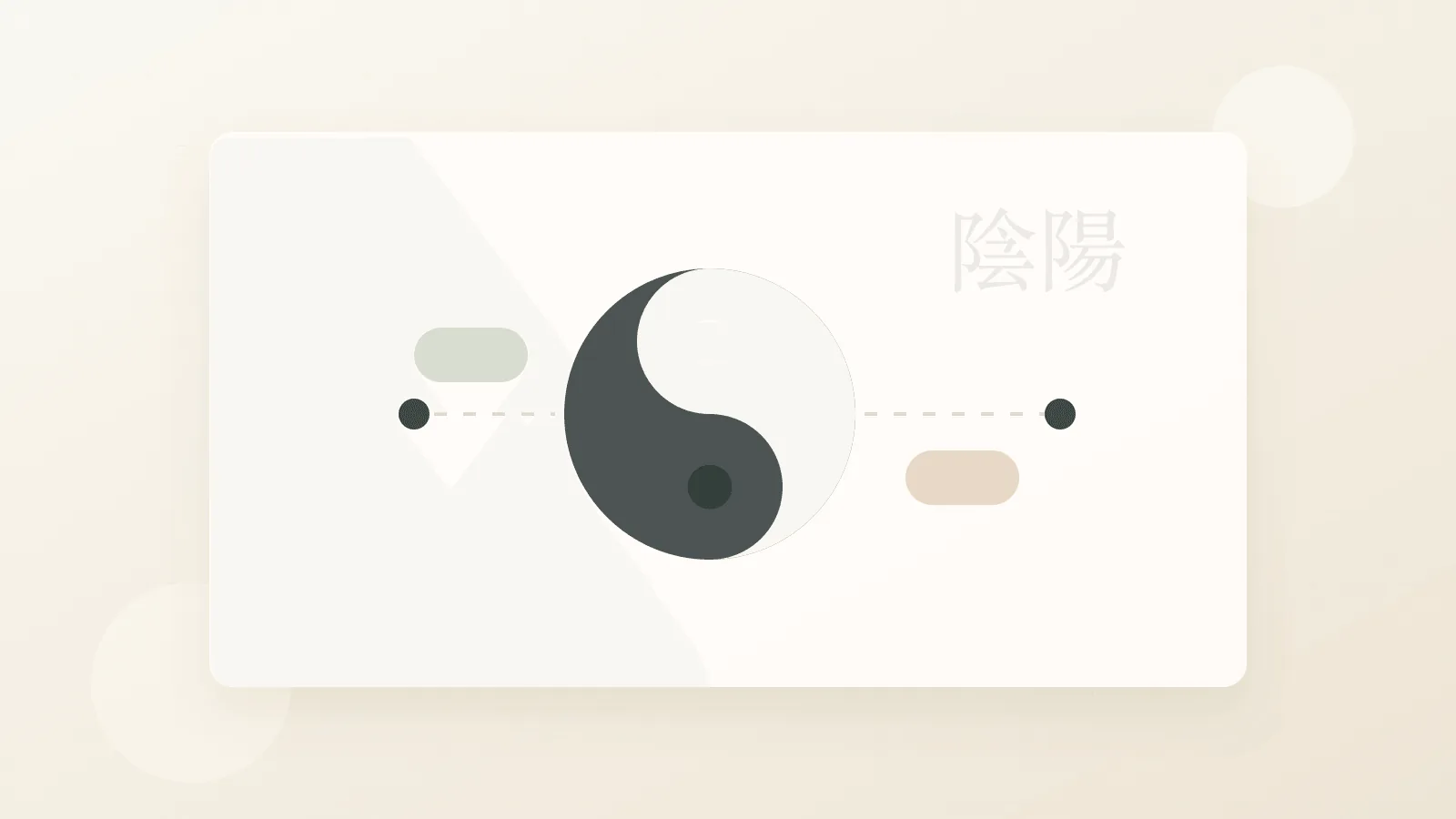
Yin and Yang are complementary patterns in Chinese thought. They describe how opposite qualities depend on each other, transform into each other, and create balance through relationship.
In daily life:
- Yin relates to rest, depth, quiet, receptivity, coolness, privacy, and recovery.
- Yang relates to action, warmth, visibility, movement, structure, expression, and output.
Neither is better. A life with too much Yang can become overexposed and exhausted. A life with too much Yin can become stagnant or withdrawn. The purpose is not to choose one side. The purpose is to understand rhythm.
Source Discipline
This article keeps Yin and Yang in Chinese cultural context before applying it to modern life.
- Classical anchor: the Yijing commentary tradition describes Yin and Yang as a changing succession rather than a static moral split.
- Translation boundary: Yin and Yang should not be reduced to good and evil, male and female, positive and negative, or personality labels.
- Modern translation: when this article discusses rest, action, privacy, visibility, recovery, and output, it is translating the relationship into modern daily language for English-speaking readers.
Chinese Cultural Root / 中国文化根基
Yin and Yang are written 陰陽 in traditional Chinese and 阴阳 in simplified Chinese. They are not a modern self-care slogan.
In Chinese thought, Yin and Yang name a relational logic: qualities arise together, depend on each other, transform into each other, and need timing. Light only makes sense beside shade. Activity needs return. Visibility needs privacy. Heat needs cooling.
This article uses modern daily language, but the root is the Chinese idea of dynamic relationship rather than a fixed binary.
Yin and Yang Are Not Good and Bad
One common mistake is treating Yang as positive and Yin as negative. That is not the meaning.
Yang can be clear, active, warm, and alive. It can also become aggressive, rushed, performative, or overheated.
Yin can be restorative, deep, receptive, and wise. It can also become stuck, hidden, cold, or avoidant.
The quality depends on context. Evening needs more Yin than midday. A launch meeting needs more Yang than a recovery ritual. A bedroom usually needs more Yin than a public workspace. A relationship needs both warmth and boundary, both expression and listening.
Balance Does Not Mean Equal Halves
The familiar black-and-white Yin-Yang image can make people think balance means a perfect fifty-fifty split. In daily life, that is rarely true.
Balance means the right quality at the right time, with the ability to change.
A morning may need more Yang because the body must wake, decide, and move. Late evening may need more Yin because the body must reduce signal and prepare for sleep. A difficult conversation may need Yang honesty and Yin listening in the same hour.
The deeper idea is alternation. A rhythm becomes unhealthy when one mode cannot yield to the other.
How to Read Yin-Yang Correctly
A careful Yin-Yang reading does not ask, "Which side am I?" It asks four more precise questions.
First, what is the context? A bedroom, a negotiation, a meal, a winter season, and a launch week do not need the same balance.
Second, what is the direction of movement? Is life becoming more outward, hotter, faster, brighter, and more visible? Or is it becoming more inward, cooler, slower, darker, and more contained?
Third, what is excessive? Yang becomes harmful when action cannot return. Yin becomes harmful when rest becomes stagnation or avoidance.
Fourth, what would allow transformation? The point is not to freeze a person into Yin or Yang. The point is to let one condition turn into the next at the right time.
This is why Yin-Yang is better understood as rhythm literacy than as a personality label.
Three Mistakes to Avoid
The first mistake is moralizing the pair: Yang as good, Yin as bad. That loses the relational meaning.
The second mistake is turning Yin and Yang into rigid gender roles. Chinese traditions have used gendered language in many contexts, but a responsible modern explanation should not use Yin and Yang to trap people inside social stereotypes.
The third mistake is treating balance as a static mood. Real balance is dynamic. A life can need more Yang in one domain and more Yin in another.
There is also a fourth mistake: making the idea too soft. Yin-Yang is not just a comforting symbol. It can be diagnostic in a plain way. If a room is meant for sleep but keeps displaying work, the issue is not an abstract lack of balance. The Yang signal has not been given an ending.
A Stricter Test Than "Balance"
The word balance is easy to say and easy to empty out. A better Yin-Yang explanation should answer three questions.
First, what is the direction of the moment: outward or inward, warming or cooling, expanding or returning?
Second, what has been overused: visibility, speed, pressure, withdrawal, privacy, or delay?
Third, what would let the condition transform instead of staying stuck?
If an article only says "balance your Yin and Yang," it has not explained much. If it helps the reader see why a bright bedroom keeps Yang active at night, or why constant privacy can become avoidance, then it is doing real work.
Yin and Yang in Modern Life
Modern life often pushes people toward constant Yang.
Screens, notifications, visibility, productivity, branding, social comparison, and speed all increase outward signal. Many people are not only busy; they are over-lit. The system keeps asking them to respond, publish, decide, perform, and explain.
That creates a common imbalance:
- high output,
- low recovery,
- constant visibility,
- weak privacy,
- too much stimulation,
- not enough completion.
This is a Yang-heavy rhythm that needs more intentional Yin.
Practical Yin Signals
Yin does not mean doing nothing. It means restoring depth, quiet, and containment.
Practical Yin signals include:
- lower evening light,
- fewer visible work objects near the bed,
- slower transitions after work,
- private time without performance,
- soft material,
- dark or quiet visual zones,
- a closing ritual before sleep,
- protected recovery windows.
Yin is not laziness. It is the condition that lets output become sustainable.
Practical Yang Signals
Yang is necessary when life needs movement, warmth, and activation.
Practical Yang signals include:
- morning light,
- decisive task lists,
- clear desk surfaces,
- movement breaks,
- social warmth,
- direct communication,
- visible goals,
- active circulation through a room.
Yang is not pressure by default. Healthy Yang creates direction.
Yin and Yang in Feng Shui
Feng Shui often works with Yin and Yang through room purpose.
A bedroom should generally support more Yin: calm light, soft texture, fewer active signals, and protected recovery.
A home office needs more Yang during work hours: clarity, upright posture, usable light, and decision structure. But if the office is inside a bedroom or small apartment, the Yang signal needs a closing boundary so it does not invade rest.
A living room needs a blend: enough Yang for warmth and conversation, enough Yin for comfort and ease.
The question is not, "Is this room Yin or Yang?" The better question is, "Does this room support the rhythm it is supposed to hold?"
A Room-Level Example
Consider a bedroom in a small apartment. During the day, the bed is beside a laptop, task light, phone charger, and open laundry. At night, the person tries to sleep in the same visual field that carried work, messages, and decisions.
A shallow reading might call the room "unbalanced." A better Yin-Yang reading is more exact: Yang signals remain active after the room should have shifted into Yin.
The adjustment is not decorative. Remove the visible work cue. Lower the light. Put the phone away from the bed. Give the day one clear ending. Yin enters when the room stops broadcasting demand.
Yin, Yang, and the Five Phases
Yin and Yang can also help clarify the Five Phases.
Wood has rising Yang movement. Fire is strongly Yang through visibility and heat. Earth can hold and integrate. Metal can contract and refine. Water is deeply Yin through storage, rest, and depth.
This does not make the phases fixed boxes. It gives readers a way to understand changing qualities within a larger rhythm.
A Daily Balance Audit
Use this simple audit at the end of the day:
- Where did my life ask for Yang today?
- Where did I overuse Yang?
- Where did my body ask for Yin?
- Did my space support recovery, or did it keep output visible?
- What one signal can I change tonight?
The answer might be small: dim a light, close the laptop, clear the first sightline, pause before responding, or make tomorrow's decision list before sleep.
Small signals matter because rhythm is built through repetition.
A Small Daily Example
Imagine a person who spends the day in calls, messaging, planning, and public output. By evening, the work is technically finished, but the phone is still bright, the desk is still visible, and the body keeps waiting for the next request.
A shallow reading might say, "You need more balance." A better Yin-Yang reading is more specific: Yang has not been given a proper ending.
The adjustment is not dramatic. Close the work surface. Lower the light. Stop checking the public channel. Give the body one repeated cue that the day has turned. Yin begins when the environment stops asking for performance.
Where to Continue
For home and work application, read Yin-Yang Balance in Home, Work, and Rest. For the related idea of vital rhythm, read What Is Qi in Chinese Culture?. For the Five Phases relationship map, read What Are the Five Elements in Chinese Culture?.
FAQ
What does Yin and Yang mean?
Yin and Yang are complementary patterns that describe relationship, change, and balance. Yin relates to rest, depth, quiet, and receptivity; Yang relates to action, warmth, movement, and expression.
Is Yin bad and Yang good?
No. Yin and Yang are both necessary. Imbalance happens when one quality dominates the wrong context or cannot transform into the other.
How can I use Yin and Yang in daily life?
Use them to read rhythm. Ask when you need action, visibility, and structure, and when you need rest, privacy, and recovery.
How does Yin and Yang relate to Feng Shui?
Feng Shui uses Yin and Yang to understand room purpose, light, activity, privacy, and sensory balance.
Why does AETERA connect Yin and Yang to modern burnout?
Modern life often creates too much Yang through speed, screens, visibility, and output. Yin-Yang gives language for identifying where recovery and containment are missing.
Is Yin-Yang the same as balance?
Balance is only part of it. Yin-Yang is more accurately a theory of relationship, alternation, and transformation. A balanced rhythm changes by context.