Direct Answer
Yin-Yang balance means adjusting the relationship between activity and recovery, stimulation and quiet, exposure and privacy, output and renewal. In daily life, it helps people read whether a space, schedule, or habit needs more movement, more rest, more structure, or more softness.
Source Discipline
This article explains Yin-Yang through Chinese cultural logic before applying it to modern life.
- Cultural anchor: 陰陽 / 阴阳 describes relational qualities, alternation, mutual dependence, and transformation.
- Translation boundary: Yin and Yang are not good and bad, male and female, positive and negative, or fixed personality types.
- Claim boundary: this article uses Yin-Yang for reflection and rhythm, not diagnosis or compatibility prediction.
Chinese Cultural Root / 中国文化根基
Yin and Yang are written 陰陽 in traditional Chinese and 阴阳 in simplified Chinese. The root idea is not a static binary. It is a way to read changing relationship: activity and rest, light and shade, expression and listening, warmth and cooling, movement and return.
This guide applies the idea to modern life without turning it into gender roles or a simplistic balance slogan.
Yin and Yang in the home
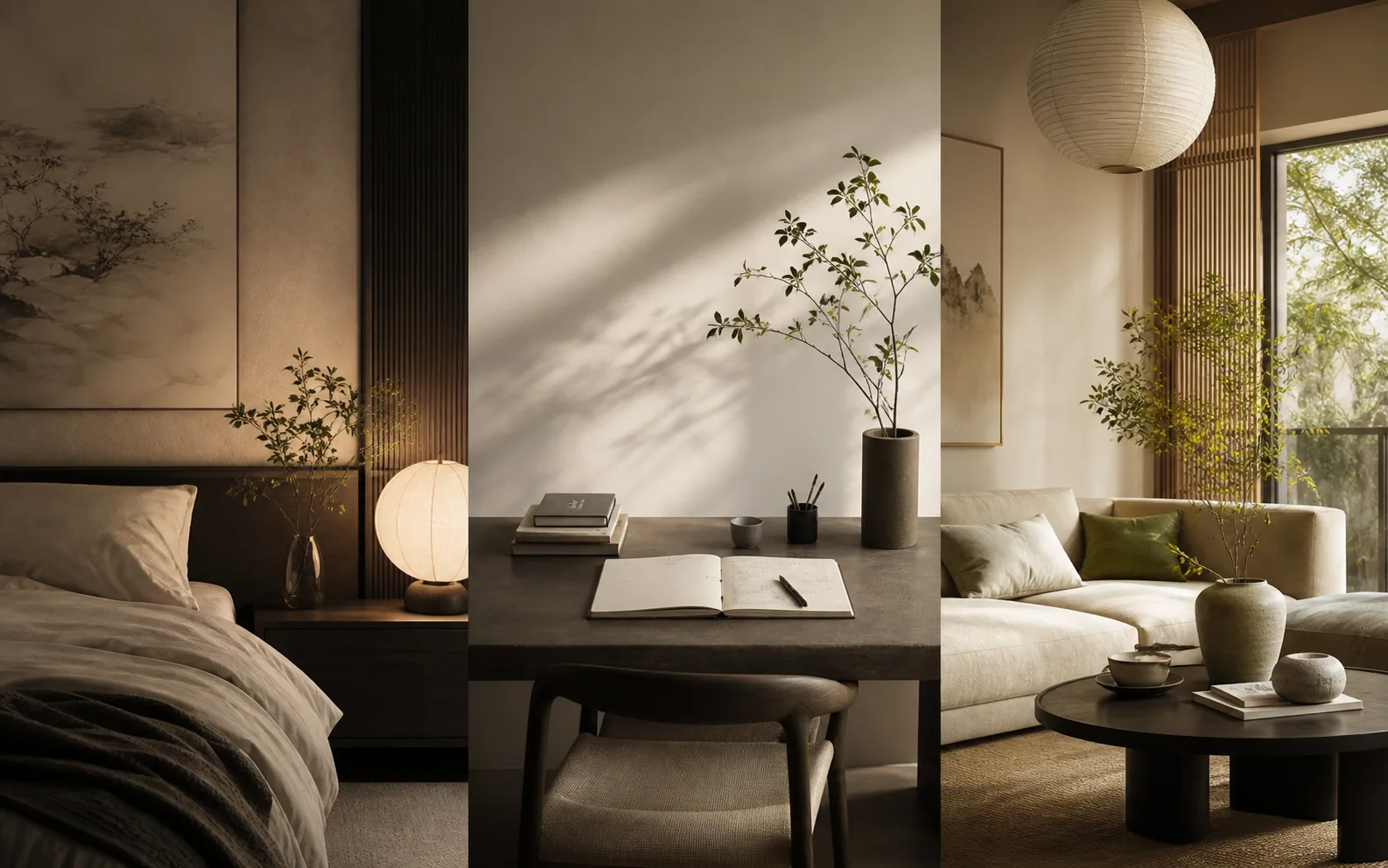
A home needs both activation and restoration. Kitchens, entries, and work areas often carry more Yang. Bedrooms, reading corners, and recovery spaces need more Yin.
Signs of too much Yang at home:
- bright light late at night
- visual clutter in rest areas
- constant sound or notification
- too many unfinished tasks in view
- no soft transition between work and sleep
Signs of too much Yin at home:
- dimness that makes action difficult
- stagnant storage
- spaces that feel heavy or unused
- lack of clear surfaces
- no place for momentum or expression
Balance does not mean every room becomes neutral. It means each room has the right rhythm for its purpose.
Yin and Yang at work
Work culture often rewards Yang: speed, visibility, production, meetings, decisions, and performance. But sustainable work also needs Yin: research, reflection, recovery, listening, and integration.
A Yang-heavy work rhythm may look productive while quietly draining judgment. A Yin-heavy work rhythm may feel thoughtful while avoiding necessary movement.
Try reading a workday in phases:
- Yang for decision windows
- Yin for research and synthesis
- Yang for presentation and collaboration
- Yin for decompression and review
The problem is not action. The problem is action without return.
Yin and Yang in rest
Rest is not simply the absence of work. Rest needs conditions. A person can lie down in a room that still feels Yang because the light, screen, clutter, or mental unfinishedness keeps the body activated.
Practical Yin cues:
- lower light
- fewer visible tasks
- warmer color temperature
- softer textures
- slower sound
- physical distance from work tools
These cues do not create magic. They help the body understand that the mode has changed.
The Transition Is the Practice
Most people do not fail at Yin-Yang balance because they never rest. They fail because there is no transition between states.
The body moves from meeting to message to dinner to screen to bed without a clear threshold. Yang does not end; it only changes costume.
Transition is the practical bridge:
- close the work surface before entering dinner,
- lower light before entering rest,
- name tomorrow's first task before ending the day,
- use one physical cue to mark that the room has changed purpose.
The transition does not need to be spiritual-looking. It needs to be repeatable.
The Real-World Test
Yin-Yang balance becomes useful only when it helps a reader name a specific mismatch.
If a bedroom is dark but still full of visible tasks, the problem is not simply that the room needs "more Yin." The room has quiet light but active demand. The body sees unfinished work even when the room looks calm.
If a workday has many meetings but no decision window, the problem is not only "too much Yang." It is visibility without closure. Yang has become performance instead of movement.
If rest becomes endless scrolling, the issue is not pure Yin. The body is still receiving Fire signal through brightness, speed, novelty, and comparison. A better adjustment may be lower light, fewer public inputs, and one clear ending cue.
This is the standard: do not use Yin and Yang as mood words. Use them to identify the exact quality that has become excessive, missing, or badly timed.
A simple daily rhythm audit
Ask four questions:
- Where is my day too Yang?
- Where is my day too Yin?
- Which transition is missing?
- What small cue would help the next state arrive?
Examples:
- If mornings are too Yin, add light, movement, and one visible plan.
- If evenings are too Yang, reduce overhead light and remove work materials from sight.
- If work is too Yang, schedule a non-output block.
- If rest is too Yin in a stagnant way, add fresh air and one clearing action.
A Grounded Example
A person may work from a laptop at the kitchen table, answer messages from bed, and scroll in the same place where they try to rest. The problem is not that the home lacks balance as an abstract ideal. The problem is that Yang activity has no ending.
A Yin-Yang adjustment would create a visible close to work, lower evening light, and protect one area from output signals. Yin begins when the environment stops asking the body to perform.
A Workday Example
A consultant may spend the morning writing alone, the afternoon in client calls, and the evening reviewing notes. The day contains both Yin and Yang, but the order matters.
If the person begins with calls, there may be too much Yang before thought has formed. If the person stays in research all day, there may be too much Yin and no outward movement. A healthier rhythm might protect a quiet morning block, use midday for visibility, and reserve late afternoon for Metal-style editing.
Yin-Yang balance becomes practical when it shapes the sequence of the day.
What this is not
Yin-Yang balance is not a moral ranking. Yang is not better than Yin. Yin is not more spiritual than Yang. The value depends on timing and context.
Where to Continue
For the main foundation, read Yin and Yang Meaning in Daily Life. For Qi, read What Is Qi?. For Five Phases, read What Are the Five Elements?.
FAQ
What does Yin-Yang balance mean in daily life?
It means reading whether a situation needs more activity, rest, brightness, quiet, expression, privacy, movement, or containment.
Is Yin bad and Yang good?
No. Yin and Yang are complementary qualities. Either can become excessive or insufficient depending on context.
How do I apply Yin and Yang at home?
Match the room's sensory cues to its purpose. Bedrooms usually need more Yin, while work areas need enough Yang for focus and momentum.