Direct Answer
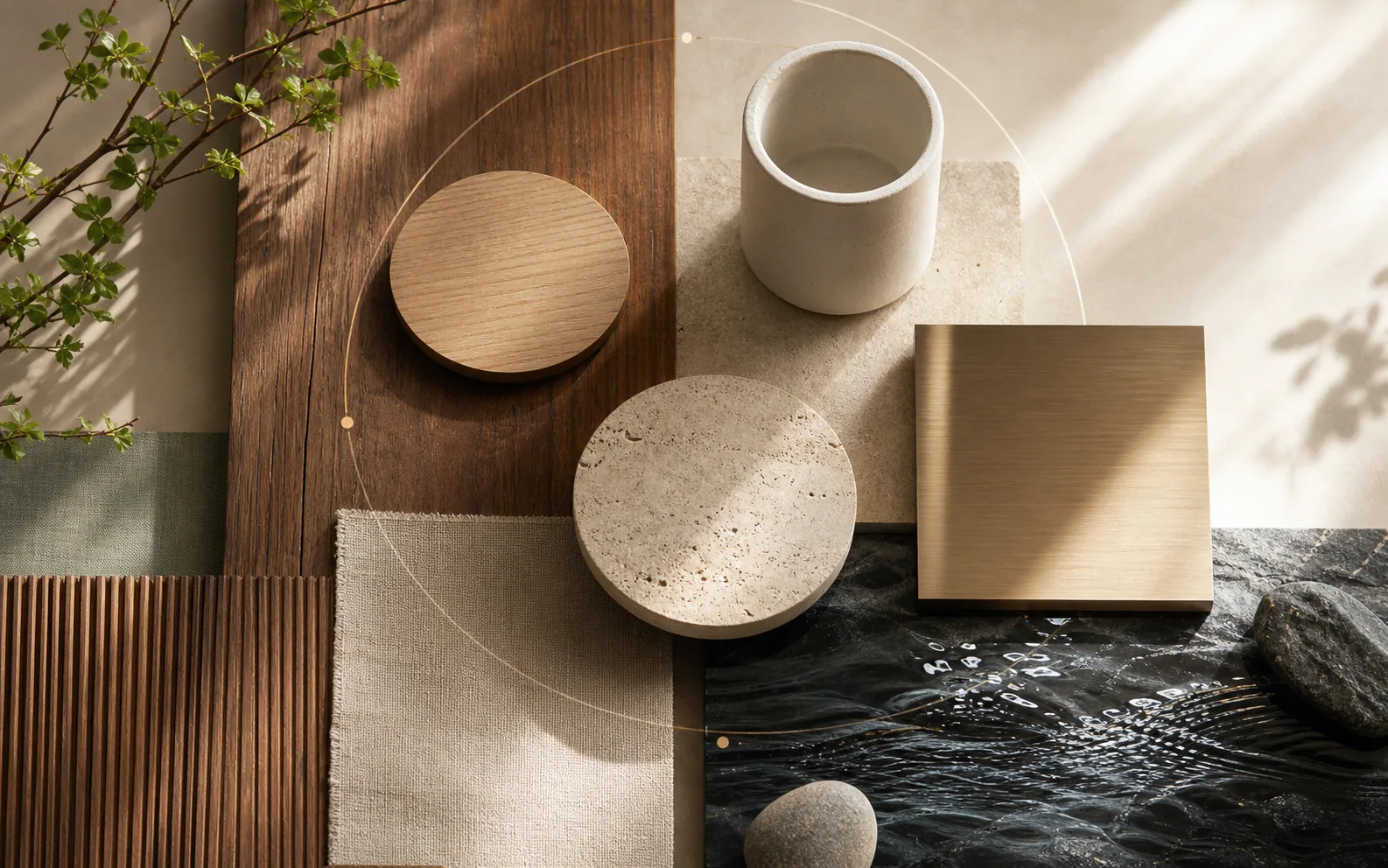
Materials, light, shape, and texture can express the Five Phases in interiors: Wood for growth, Fire for visibility, Earth for support, Metal for refinement, and Water for depth. The goal is not lucky decoration but a room whose physical signals match its purpose.
Source Discipline
This article uses Wu Xing as a Chinese cultural framework and keeps the following boundaries.
- Classical anchor: 五行 names Wood, Fire, Earth, Metal, and Water as movement qualities and relationships.
- Translation boundary: Five Elements is the familiar English phrase; Five Phases is often more precise because the system describes process and change.
- Claim boundary: the article does not treat an element as fixed destiny, medical diagnosis, or guaranteed personality truth.
Chinese Cultural Root / 中国文化根基
The Chinese root is 五行: 木 Wood, 火 Fire, 土 Earth, 金 Metal, 水 Water. These are not only materials or personality labels. They are a Chinese way of reading growth, expression, stability, refinement, restoration, support, and regulation.
Keeping the Chinese term visible prevents the article from drifting into generic wellness or Western four-element language.
Wood: growth and direction
Wood is not only plants. It appears through vertical lines, natural fibers, upward movement, planning surfaces, growth cues, and flexible organization.
Useful Wood expressions:
- healthy plants
- wood furniture
- vertical shelving
- green accents
- planning boards
- morning light
Too much Wood may feel busy, overgrown, or constantly unfinished.
Fire: visibility and warmth
Fire appears through light, warmth, color intensity, display, social energy, and attention. It is powerful in kitchens, gathering spaces, creative studios, and public-facing areas.
Useful Fire expressions:
- layered lighting
- candles used safely
- warm tones
- art or focal points
- expressive objects
- social seating
Too much Fire can make a room feel overstimulating, performative, or hard to rest in.
Earth: stability and support
Earth appears through weight, softness, ceramics, low forms, square shapes, grounded colors, and tactile comfort. It is often important in bedrooms, dining spaces, and recovery areas.
Useful Earth expressions:
- rugs
- ceramics
- warm neutrals
- low tables
- soft seating
- objects with visual weight
Too much Earth can become heavy, stagnant, or resistant to change.
Metal: refinement and boundaries
Metal appears through clean edges, organization, pale tones, hardware, reflective surfaces, edited forms, and precision. It supports focus, standards, and completion.
Useful Metal expressions:
- uncluttered surfaces
- defined storage
- white or gray accents
- metal hardware
- clear desk boundaries
- edited object count
Too much Metal can feel cold, sterile, or overly controlled.
Water: depth and restoration
Water appears through darkness, reflection, curves, quiet, depth, and contemplative mood. It is useful where a room needs recovery, imagination, or inwardness.
Useful Water expressions:
- dark accents
- mirrors used carefully
- curved forms
- quiet corners
- soft contrast
- uncluttered visual depth
Too much Water can feel vague, heavy, or under-activated.
Designing with relationships
Do not ask, "Do I have all five elements?"
Ask:
- What does this room need to do?
- Which quality is missing?
- Which quality is excessive?
- Which material change would support the room's purpose?
A home office may need Metal for boundaries, Wood for direction, and enough Fire for visibility. A bedroom may need Earth and Water, with Fire reduced at night. A living room may need Earth for gathering and Fire for warmth.
Where Design Advice Becomes Too Shallow
A shallow Five Elements design guide treats every object as a symbol. Green means Wood. Red means Fire. White means Metal. Black means Water. Yellow means Earth.
That is not enough for a real room.
An oak desk covered with open tasks may contain literal Wood, but the room may still lack healthy Wood because direction is unclear.
A black accent wall does not automatically create Water if the room is dominated by screens, glare, noise, and social performance.
A beautiful stone table does not automatically create Earth if the room gives no one a place to gather, eat, pause, or feel supported.
Material matters, but behavior decides whether the material is doing cultural work. The question is always: what rhythm does this room train?
Material Combinations That Actually Work
The Five Phases become more useful when they describe relationships between materials.
A bedroom may combine Earth and Water through soft textiles, grounded color, low light, and quiet visual depth. Adding more Fire through bright overhead lighting may work in the morning but damage recovery at night.
A home office may combine Wood and Metal through a clear planning surface, vertical shelving, edited tools, and a strong boundary around unfinished tasks. Too much Wood without Metal becomes scattered expansion. Too much Metal without Wood becomes sterile control.
A living room may combine Earth and Fire through comfortable seating, warm light, and a visible gathering point. If the room also needs Water, that might appear as quieter corners, acoustic softness, or less screen dominance.
The point is relationship. A material is not good by itself. It is useful when it supports the room's role.
Why this matters for future products
For AETERA, this framework matters because future objects should not be marketed as lucky charms. A product can support a phase quality through material, light, texture, placement, and use. That is more trustworthy than promising wealth or protection.
A product should be able to answer a serious question: which phase quality does it support, in what room, and through what behavior? If the answer is only "because it is lucky," the product does not meet AETERA's standard.
For example, a future ritual object should not be sold as "Metal for wealth." A stronger claim would be narrower: this object creates a visible closing place for keys, cards, or work tools, helping the entryway carry Metal clarity and reduce first-signal clutter.
That is the level of specificity required for trustworthy Five Elements design.
A Grounded Example
A home office with bright overhead light, cold surfaces, and too many visible tools may look efficient but feel tense. The issue is not that Metal is bad. The issue is that Metal has become excessive without enough Earth support or Water recovery.
A better adjustment might keep the clear desk, add one grounded material, soften the light after work, and create a closing ritual. The Five Elements become useful when material choices support a room's job.
Where to Continue
For the full foundation, read What Are the Five Elements in Chinese Culture?. For the cycles, read How Do the Five Elements Work?. For home application, read How to Use the Five Elements in Your Home.
FAQ
Are Five Elements interior design rules about color?
Color is one layer, but materials, shape, light, texture, and room function matter more than simple color matching.
Do I need all five elements in every room?
No. Each room should support its purpose. Some rooms need more Earth and Water, while others need more Wood, Fire, or Metal.
Is this Feng Shui?
It is related to Feng Shui because Five Phase thinking is used in Chinese spatial culture. AETERA teaches it as practical pattern language, not lucky-object decoration.