Direct Answer
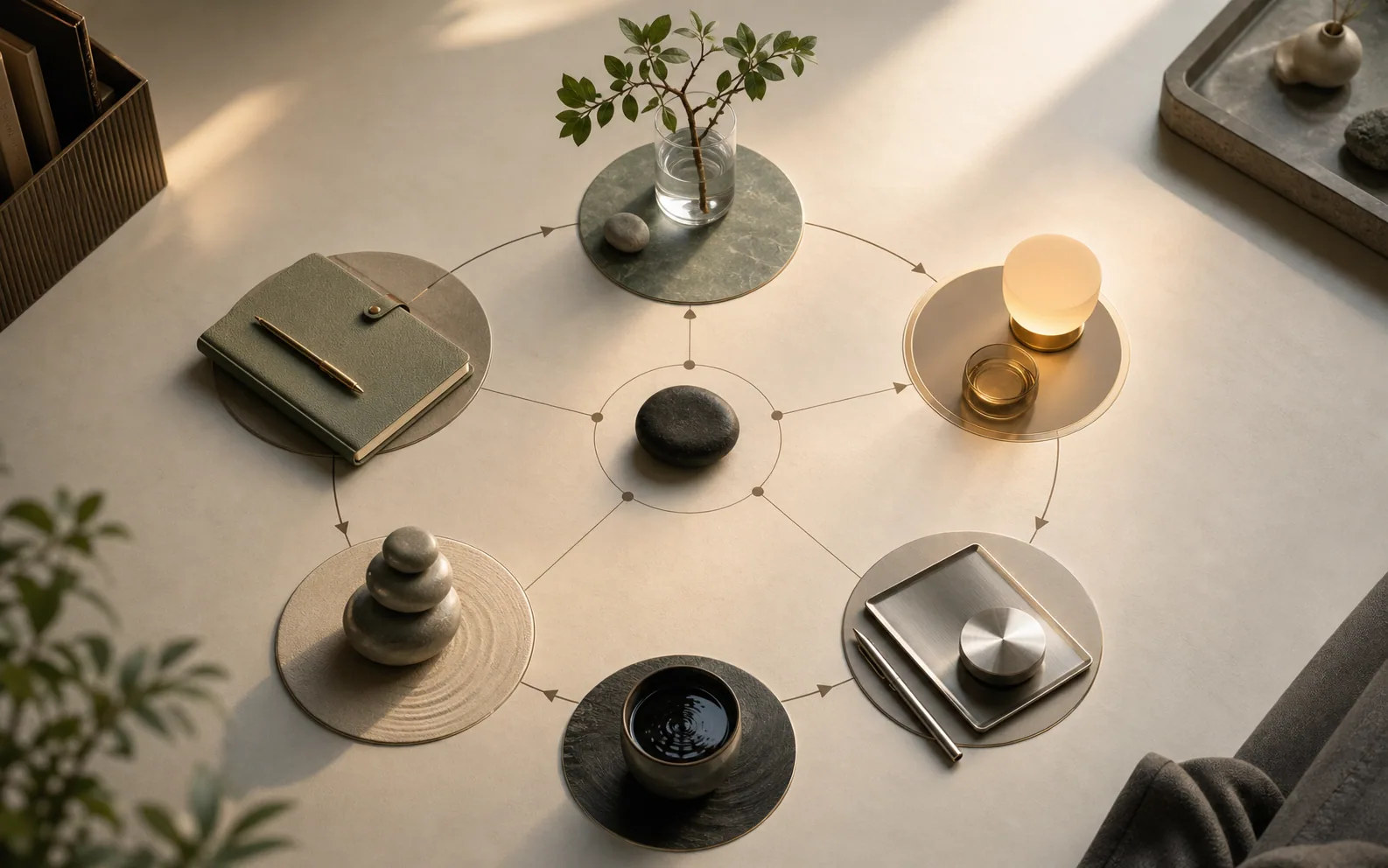
The Five Elements can help organize work rhythm by separating planning, visibility, support, focus, and recovery. Wood begins, Fire shares, Earth integrates, Metal edits, and Water restores. The method is useful because not every workday should demand the same kind of energy.
Source Discipline
This article uses Wu Xing as a Chinese cultural framework and keeps the following boundaries.
- Classical anchor: 五行 names Wood, Fire, Earth, Metal, and Water as movement qualities and relationships.
- Translation boundary: Five Elements is the familiar English phrase; Five Phases is often more precise because the system describes process and change.
- Claim boundary: the article does not treat an element as fixed destiny, medical diagnosis, or guaranteed personality truth.
Chinese Cultural Root / 中国文化根基
The Chinese root is 五行: 木 Wood, 火 Fire, 土 Earth, 金 Metal, 水 Water. These are not only materials or personality labels. They are a Chinese way of reading growth, expression, stability, refinement, restoration, support, and regulation.
Keeping the Chinese term visible prevents the article from drifting into generic wellness or Western four-element language.
Wood: planning and growth
Wood is the phase of direction. In work, it appears as strategy, ideation, goal setting, expansion, and new beginnings.
Wood questions:
- What is growing?
- What needs direction?
- Which plan is too vague?
- Where do I need a next step?
Wood becomes unhealthy when planning never becomes action.
Fire: visibility and expression
Fire is the phase of attention. In work, it appears as presentations, launches, meetings, leadership visibility, storytelling, and social energy.
Fire questions:
- What needs to be seen?
- What message needs warmth?
- Where is momentum useful?
- Where am I performing without substance?
Fire becomes unhealthy when visibility replaces depth.
Earth: support and integration
Earth is the phase of holding. In work, it appears as team care, documentation, onboarding, operational support, and making complexity digestible.
Earth questions:
- What needs stabilizing?
- Who needs support?
- What process is unclear?
- What should be made easier to use?
Earth becomes unhealthy when support turns into overgiving.
Metal: focus and boundaries
Metal is the phase of refinement. In work, it appears as editing, standards, prioritization, contracts, structure, and saying no.
Metal questions:
- What should be removed?
- What standard matters?
- Which meeting should not exist?
- Where do I need a boundary?
Metal becomes unhealthy when control blocks collaboration.
Water: recovery and strategy
Water is the phase of depth. In work, it appears as research, rest, reflection, pattern recognition, and long-range strategy.
Water questions:
- What do I need to understand before acting?
- What needs rest?
- What is the deeper pattern?
- Where am I avoiding stillness?
Water becomes unhealthy when reflection turns into withdrawal.
A weekly Five Phase rhythm
A practical work week might look like this:
- Monday: Wood planning
- Tuesday: Fire communication
- Wednesday: Earth operations and support
- Thursday: Metal editing and decisions
- Friday: Water review and recovery
This is not a traditional rule. It is a modern rhythm design inspired by Five Phase logic.
Project Rhythm, Not Just Weekly Rhythm
The same logic can apply to a single project.
Wood is the first sketch: define the direction, name the problem, collect possibilities.
Fire is the moment of expression: present the idea, test the message, gather response.
Earth is integration: document what was learned, support the team, make the work usable.
Metal is refinement: edit, cut, prioritize, decide, and close loops.
Water is recovery and strategy: step back, observe the pattern, and let the next beginning become clearer.
Many teams burn out because they stay in Fire and Metal: constant visibility and constant judgment. They skip Water, then wonder why the next Wood phase has no vitality.
The Work Rhythm Failure Pattern
The most common modern work distortion is not laziness. It is phase compression.
One hour asks for Wood planning, Fire visibility, Earth support, Metal judgment, and Water reflection at the same time. A person opens a document, responds to a message, joins a call, edits yesterday's work, and tries to think strategically in the same mental field.
That compression creates friction. Wood cannot grow because Metal is judging too early. Water cannot restore because Fire keeps demanding visibility. Earth cannot support the team because every process is still changing.
A Five Phases work practice separates modes. It protects planning from premature critique, visibility from empty performance, support from overgiving, editing from harshness, and recovery from guilt.
The practical value is not a prettier calendar. It is fewer contradictions inside the same work block.
A Grounded Example
A week full of meetings, launches, and messages is Fire-heavy. If there is no Metal boundary, decisions blur. If there is no Water recovery, the next week begins already depleted.
A Five Phases work rhythm might reserve Wood for planning, Fire for sharing, Earth for support, Metal for editing, and Water for review. The point is not to force a formula. The point is to stop asking every day to carry the same quality.
A Remote Work Example
Remote work often removes natural endings. There is no commute, no office door, and no visible transition from work identity to home rhythm.
Use the Five Phases to create endings:
- Wood: write tomorrow's first direction.
- Fire: send the final visible update.
- Earth: tidy the shared context so no one is left guessing.
- Metal: close the tabs and choose what will not continue tonight.
- Water: create a short non-output interval before the evening.
This is not productivity theater. It is rhythm protection.
A Managerial Use Case
For a founder, manager, or solo consultant, the Five Phases can also prevent poor sequencing.
Do not ask a team to brainstorm and finalize in the same meeting unless the boundary is explicit. That mixes Wood and Metal too sharply.
Do not launch a public campaign before the support system is ready. That puts Fire before Earth.
Do not add another growth channel when the existing channel has no review rhythm. That adds Wood before Water and Metal have done their work.
This is where Wu Xing becomes more than personal reflection. It becomes a way to read whether work is being asked to move in an order it cannot sustain.
What this is not
This is not a productivity hack promising success. It is not a personality typing system. It is a way to observe which work mode is overused, missing, or needed next.
Where to Continue
For the full foundation, read What Are the Five Elements in Chinese Culture?. For the cycles, read How Do the Five Elements Work?. For home application, read How to Use the Five Elements in Your Home.
FAQ
Can the Five Elements help with work?
Yes, as a reflection framework. They can help identify whether work needs planning, visibility, support, boundaries, or recovery.
Is my work element fixed?
No. AETERA does not treat elements as fixed identity labels. Different projects and seasons require different phase qualities.
Which element helps with focus?
Metal often supports focus through boundaries, refinement, and editing. Wood also helps when focus requires direction and planning.