Direct Answer
Qixi Festival is on Wednesday, August 19, 2026. It is observed on lunar 7/7 and is widely associated with the story of Niúláng (牛郎, the Cowherd) and Zhīnǚ (织女, the Weaver Girl). Modern couples may celebrate with dates and gifts, which makes the Valentine's comparison understandable. Yet the historical festival is not simply a Chinese copy of Valentine's Day: Qiqiao practices placed weaving, needlework, ingenuity, women's gatherings, and the display of skill near the center of the occasion.
Source Discipline
The 2026 date comes from the Hong Kong Observatory's official Gregorian-lunar conversion table. Cultural descriptions in this guide draw on Chinese government cultural resources that document the Cowherd-Weaver Girl narrative, regional Qiqiao practices, foods, craft displays, and modern romantic celebration.
No single custom represents every period or region. Festival stories also belong to folklore and literary tradition; they are not astronomical explanations. The stars Vega and Altair are real, while the lovers and their annual reunion belong to cultural story. AETERA preserves that distinction without treating the story as disposable.
Chinese Cultural Root / 中国文化根基
The date is written 七月初七, the seventh day of the seventh lunar month. 七夕 combines 七, seven, with 夕, evening. Another enduring name is 乞巧节 (Qǐqiǎo Jié). 乞巧 is often translated as "pleading for skill" or "begging for cleverness," especially skill associated historically with textile work and the figure of the Weaver Girl.
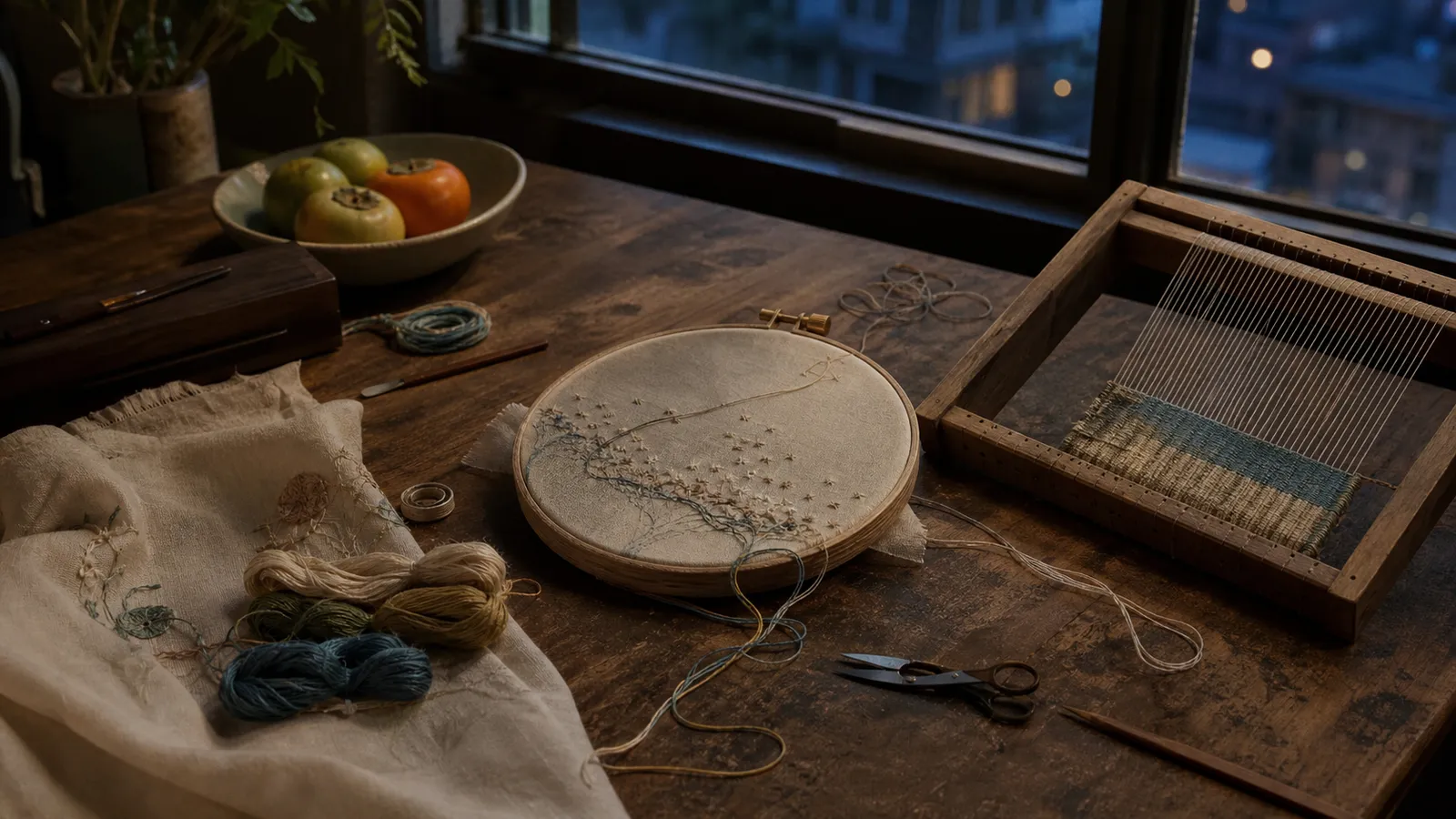
The vocabulary changes the center of the festival. If Qixi is introduced only as a romantic date night, 乞巧 disappears. Once Qiqiao is restored, the festival becomes a scene of making and evaluation: threading needles, displaying embroidery, shaping foods, arranging fruit, and gathering with other women. Romance remains important, but it is not the only inheritance.
Why August 19 Is the 2026 Qixi Date
Chinese traditional festivals follow the lunisolar calendar, so their Gregorian dates move from year to year. The Hong Kong Observatory table maps August 13, 2026, to the first day of the seventh lunar month. Counting forward places lunar 7/7 on August 19.
This is also why Qixi cannot be assigned a fixed August date like a modern civic holiday. The stable part is the lunar date; the changing part is its conversion into the Gregorian calendar used by most North American readers.
For a wider explanation of the two calendars and seasonal time, see Chinese Time Wisdom.
The Cowherd and Weaver Girl Tradition
The best-known Qixi story tells of Niúláng, a cowherd, and Zhīnǚ, a celestial weaver. They are separated by the Milky Way and allowed to reunite on the seventh night of the seventh lunar month, often with a bridge formed by magpies in later popular tellings. Versions differ, as living folktales do.
The sky supplies the story's visible structure. Altair is associated with the Cowherd Star, while Vega is associated with the Weaver Girl Star; the Milky Way lies between them. Observing those stars gave seasonal experience a memorable human form. The tale holds distance and reunion together, which is one reason it remains emotionally durable.
It is better to call this star lore than to claim the festival is caused by a special astronomical event. The cultural map and the astronomical map can occupy the same sky without being the same kind of explanation.
Qiqiao: Skill Was Not a Side Detail
Historical and regional accounts repeatedly place craft at the center of the festival. Young women threaded needles, compared handiwork, made small objects, prepared patterned foods, carved fruit, or displayed elaborate arrangements. Some practices asked the Weaver Girl for dexterity; others tested or celebrated skill already learned.
These activities took place within historical gender roles. Textile skill could affect a woman's reputation and household position, so Qiqiao was not merely a charming hobby night. It joined labor, aesthetics, aspiration, friendship, and social judgment. Modern readers should neither romanticize those constraints nor erase the agency and community women made within them.
The festival's objects therefore carry more weight than generic romance merchandise. A length of thread can point to patience, training, and visible competence. A shared table can show women teaching, comparing, teasing, and recognizing one another's work. "Chinese Valentine's Day" does not capture that social world.
How the Valentine's Comparison Helps and Distorts
The shorthand helps because contemporary Qixi in China does include flowers, gifts, restaurant bookings, and romantic messages. It gives an unfamiliar festival an immediate North American reference point.
The distortion begins when the reference point replaces the subject. Valentine's Day is fixed on February 14; Qixi follows lunar 7/7. Valentine's imagery centers hearts and couples; Qixi's inherited imagery includes weaving, stars, seasonal fruit, women’s gatherings, and a reunion made meaningful by separation. Calling Qixi "Chinese Valentine's Day" is useful in one sentence and inadequate as the whole article.
A more accurate summary is: Qixi is a traditional seventh-night festival whose craft and star-lore traditions have acquired a strong modern romantic expression.
A Contemporary Diaspora Example
Consider a Chinese cultural association in Seattle planning an August 19 program. A shallow version would decorate the room with hearts and advertise a singles event. A more grounded program might invite a textile artist to demonstrate embroidery, place Vega and Altair on a simple night-sky map, serve one regional form of 巧果 (qiǎoguǒ) with its origin clearly named, and make room for participants to share what "skill" means in their own family histories.
Couples could still attend. So could friends, children, elders, and people who are not seeking romance. The program would not reproduce an ancient Qiqiao gathering, and it should not claim to. It would use documented festival layers to create an honest contemporary encounter.
This distinction is central to cultural translation: adaptation is legitimate when it names itself. A newly designed workshop becomes misleading only when marketing presents it as the one timeless way Chinese people have always celebrated.
A Modern Way to Read the Festival
Qixi can prompt three grounded questions.
First, what skill in your family or community deserves to be seen rather than treated as invisible labor? Second, what relationship has been sustained through distance, timing, or patient return? Third, what can the late-summer sky teach simply because you took time to look?
These are modern prompts, not classical Qixi instructions. They follow from the festival's documented themes without pretending that reflection language is ancient ritual.
What This Does Not Mean
Qixi does not guarantee reunion, improve romantic luck, identify a soulmate, or determine compatibility. The Cowherd-Weaver Girl story should not be used as evidence that suffering proves a relationship is destined.
Nor does celebrating Qixi require purchasing a symbolic object. Gifts can be part of modern observance, but they do not carry automatic cultural or spiritual effects. AETERA does not assign gemstones, colors, or products the power to secure love.
Finally, Qixi is not evidence that all Chinese women historically shared one experience. Practices differed by class, region, period, age, and community. The festival offers a rich record precisely because its meanings were made in many places.
Where to Continue
For the calendar behind lunar 7/7, visit Chinese Time Wisdom. For a Chinese framework that reads relationship through alternation rather than fixed gender stereotypes, continue to Yin-Yang and Relationship Rhythm. Research principles and Chinese-language references are available in the AETERA Cultural Source Library.
FAQ
What date is Qixi Festival in 2026?
Qixi Festival falls on August 19, 2026. Its traditional date is the seventh day of the seventh lunar month.
Is Qixi the Chinese Valentine's Day?
That is a useful modern shorthand because couples now celebrate romantically, but it is incomplete. Qixi also has deep associations with Qiqiao skill practices, women's gatherings, textile work, star lore, longing, and reunion.
What does Qixi mean in Chinese?
七夕 (Qixi) means the evening of the seventh, referring to lunar 7/7. The festival is also called 乞巧节 (Qiqiao Festival), referring to pleading for skill or ingenuity.
Who are the Cowherd and Weaver Girl?
Niúláng and Zhīnǚ are the separated figures in Qixi's best-known folktale. Their story is associated with Altair and Vega on opposite sides of the Milky Way and with an annual reunion on lunar 7/7.
How was Qixi traditionally celebrated?
Practices varied, but documented customs include threading needles, displaying needlework and handmade objects, arranging fruit, making qiǎoguǒ, observing stars, and gathering for Qiqiao activities.
Can someone celebrate Qixi without a romantic partner?
Yes. Romance is only one layer. Learning a craft, gathering with friends or family, observing the summer sky, or studying a regional tradition can all engage the festival without inventing spiritual claims.
Sources and further reading
- Hong Kong Observatory: Gregorian-Lunar Calendar Conversion Table of 2026
- Ministry of Culture and Tourism of China: The Origins and Customs of Qiqiao Festival
- Shanghai Municipal Government: The Story Behind Qixi Festival
- Hebei Provincial Department of Culture and Tourism: Qixi Cultural Traditions
- AETERA Cultural Source Library